- THESIS
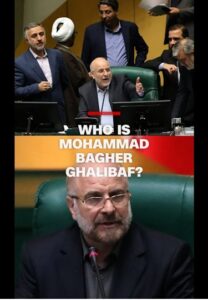
Mohammad Bagher Ghalibaf is not negotiating for peace—he is negotiating to survive, consolidate power, and outmaneuver rivals inside a weakening regime.
Misinterpreting this behavior as strategic moderation risks policy failure at the structural level.
- WHY GHALIBAF WOULD ENGAGE THE UNITED STATES (MOTIVATION ANALYSIS)
PRIMARY DRIVERS
- Ghalibaf has a clear incentive to reduce external military and economic pressure in order to stabilize internal factional competition, particularly among IRGC-aligned networks.¹
- He benefits from positioning himself as a capable intermediary, which increases his relevance to both IRGC leadership and external actors seeking actionable channels.²
- Engagement with the United States signals to domestic rivals that Ghalibaf operates at the highest strategic level, making him more difficult to sideline within internal power competition.²
SECONDARY DRIVERS
- Iran’s oil exports, estimated between 1.2–1.5 million barrels per day under sanctions constraints, remain vulnerable to escalation, giving Ghalibaf an incentive to support pressure-reduction mechanisms.³
- Approximately 20% of global oil trade passes through the Strait of Hormuz, making instability economically consequential and politically exploitable.⁴
- Ghalibaf can leverage negotiation narratives to differentiate himself from ideologically rigid factions while maintaining hardline credentials.²
These economic exposure points create incentives for actors like Ghalibaf to support controlled de-escalation that preserves revenue flows without signaling strategic weakness.
CONSTRAINT
- Ghalibaf must avoid any perception of pro-West alignment, as such positioning would trigger internal legitimacy risks within hardline coalitions and IRGC-linked networks.²
Conclusion: Negotiation functions as a tactical instrument for internal positioning, not as a strategic shift toward reconciliation.
III. LEADERSHIP STYLE (EXPANDED ANALYSIS)
MODEL: SECURITY-DRIVEN EXECUTIONAL PRAGMATIST
- Ghalibaf consistently prioritizes operational control, institutional stability, and execution efficiency over ideological messaging.¹
- His leadership reflects a hybrid model combining military command discipline with technocratic governance experience, developed during his tenure as Tehran mayor.¹
- He demonstrates adaptive messaging, shifting tone depending on domestic or international audiences while maintaining regime alignment.²
DECISION-MAKING PROFILE
- He centralizes execution once authority is secured but operates through network-building during periods of uncertainty.²
- He relies on informal influence channels, particularly IRGC-linked relationships, rather than formal institutional authority.²
- He advances incrementally, avoiding direct confrontation with supreme leadership while expanding functional control across overlapping systems.
RISK ORIENTATION
- He is a calculated risk-taker, willing to act during instability but avoiding irreversible political exposure.
- His flexibility makes him adaptive but strategically ambiguous, complicating external assessment.
Bottom line: He is a system optimizer operating within constraint, not a doctrinal ideologue.
- PATH TO POWER — HOW HE BECAME SPEAKER
INSTITUTIONAL ASCENT
- Ghalibaf’s early career in the Islamic Revolutionary Guard Corps embedded him within Iran’s core security elite during formative post-revolutionary years.¹
- His tenure as national police chief (2005–2008) reinforced his role in domestic security enforcement and crisis response management.¹
- As mayor of Tehran (2005–2017), he developed a reputation for urban management, infrastructure expansion, and administrative execution.¹
PARLIAMENTARY ASCENT (2020 ELECTION CONTEXT)
- The 2020 parliamentary elections were marked by historically low turnout (approximately 42%), reflecting public disengagement and enabling conservative consolidation.⁵
- Conservative “principalist” factions secured overwhelming control, marginalizing reformist representation.⁵
- Ghalibaf was elected Speaker with strong backing from dominant conservative blocs, including the Coalition Council of Islamic Revolution Forces.⁵
- THE PARLIAMENTARY COALITION AND POWER BASE
CORE FACTION: PRINCIPALISTS (OSOULGARAYAN)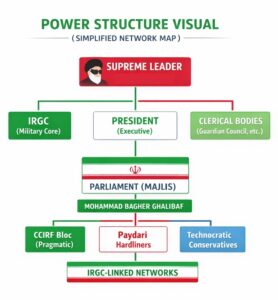
- The principalist movement emphasizes:
- Preservation of the Islamic Republic
- Resistance to Western influence
- Alignment with IRGC strategic priorities
KEY BLOCS AND FIGURES
- The Coalition Council of Islamic Revolution Forces (CCIRF) functions as a central organizing body for conservative electoral coordination.⁵
- The Paydari Front (Steadfastness Front) represents a more ideologically rigid faction that competes with pragmatic conservatives like Ghalibaf.⁵
- Ghalibaf operates as a bridge between technocratic conservatives and security-aligned factions, allowing him to maintain coalition relevance.
His position remains structurally fragile, as ideological factions such as the Paydari Front view his pragmatism as a potential threat to ideological purity.
CONTROL MECHANISM
- He exerts influence through committee assignments, legislative agenda control, and alliance management across factions.
- His authority depends on continuous balancing between competing conservative blocs, rather than absolute control.
Conclusion: He leads through coalition management under tension, not hierarchical dominance.
- AREAS OF LIMITED ALIGNMENT WITH THE UNITED STATES
- Both Iran and the United States share an interest in avoiding uncontrolled escalation that could disrupt global energy markets, particularly given Hormuz transit volumes.⁴
- Both actors benefit from maintaining predictable maritime trade flows, even amid strategic competition.⁴
- Both sides have an interest in preventing unauthorized escalation by non-state actors, particularly in Iraq, Syria, and the Gulf.⁶
- Both may support indirect communication channels to reduce miscalculation risks during active conflict conditions.
VII. AREAS OF FUNDAMENTAL NON-ALIGNMENT
- Iran seeks to remove U.S. military and political presence from the Middle East, while the U.S. maintains forward deployment of approximately 30,000–40,000 personnel in the region.⁶
- Iran supports proxy groups (e.g., Hezbollah, regional militias), while the U.S. classifies these networks as destabilizing actors.⁶
- Iran maintains a strategic posture against Israel, while the U.S. provides Israel with sustained military and diplomatic support.⁶
- Iran resists integration into Western-led economic systems, instead prioritizing alignment with China and Russia.²
Conclusion: The relationship is defined by structural opposition with narrow tactical overlap.
VIII. REPRESENTATIVE QUOTATIONS (ATTRIBUTED SIGNALING)
ON THE UNITED STATES
“The United States cannot impose its will on
the Iranian nation through pressure and threats.”¹
This framing reinforces resistance while preserving space for indirect engagement, allowing Ghalibaf to balance domestic hardline expectations with tactical flexibility.
ON ISRAEL
“The Zionist regime is the primary source of insecurity in the region.”⁷
This reinforces ideological alignment with regime doctrine while signaling continued regional confrontation.
ON WAR AND RESPONSE
“Iran will respond firmly and decisively to any act of aggression.”⁷
This establishes deterrence signaling while maintaining escalation flexibility.
ON THE GLOBAL ECONOMY
“The global economic order is shifting away from Western dominance,
and Iran must position itself within emerging economic blocs.”²
This framing supports a strategic pivot away from Western economic systems while justifying alignment with alternative power blocs such as China and Russia.
ON ENERGY AND HORMUZ
“The Strait of Hormuz will not return to previous
conditions under continued external threats.”⁷
This signals willingness to leverage chokepoint disruption as a strategic pressure tool.
- STRATEGIC TAKEAWAY
Ghalibaf’s behavior is best explained by a single governing principle: Ghalibaf is not managing instability—he is using it to accumulate power.
- ASSESSMENT
Mohammad Bagher Ghalibaf is best understood as: A security-aligned power broker navigating and exploiting fragmentation within Iran’s governing system under sustained external pressure:
- He is too embedded within the regime to function as a reformist actor.
- He is too ambitious to remain a passive institutional figure.
- He is too constrained by competing power centers to act independently.
Conclusion: Engagement with Ghalibaf must remain structurally informed, tactically cautious, and strategically limited.
- POWER STRUCTURE VISUAL (SIMPLIFIED NETWORK MAP)
INTERPRETATION
- Real power flows vertically through the Supreme Leader and IRGC, not horizontally through parliament.
- Ghalibaf’s influence depends on his ability to connect parliamentary authority to IRGC-aligned networks.
- His position is best understood as a bridge node, not a command node.
- This structure explains why engagement with parliament alone cannot produce enforceable outcomes in Iran’s system.
XII. SUCCESSION IMPLICATIONS (POST–KHAMENEI SCENARIO)
Ghalibaf’s current positioning must be evaluated within the context of an eventual post-Ali Khamenei succession environment, where Iran’s leadership structure is likely to shift from centralized clerical authority toward a more security-dominated hybrid model. In such a scenario, Ghalibaf is unlikely to emerge as Supreme Leader; however, he is well-positioned to play a critical coordinating or executive role within a collective leadership arrangement, particularly one shaped by IRGC influence. His combination of operational credibility, political experience, and factional connectivity makes him a viable candidate for roles such as president, transitional executive authority, or parliamentary power broker within a rebalanced system. His strategic objective, therefore, is not succession in the traditional sense, but indispensability during transition, ensuring that any future configuration of power must account for his networks and capabilities.
XIII. CONSTITUTIONAL TRAJECTORY (PROBABILITY OF STRUCTURAL CHANGE)
The probability of a fully new constitution in Iran remains low in the near term; however, the likelihood of targeted constitutional reinterpretation or amendment is materially higher under sustained internal and external pressure. Iran’s existing constitutional framework already contains mechanisms for elastic interpretation through bodies such as the Guardian Council and Expediency Discernment Council, allowing significant functional change without formal overhaul. In a post-crisis or post-succession environment, reforms could include rebalancing executive authority, formalizing the role of security institutions, or adjusting the relationship between elected and unelected bodies. Ghalibaf, given his hybrid background, is structurally aligned with a model that would increase executive efficiency while preserving regime continuity, rather than pursuing liberalization. As a result, any constitutional evolution he supports would likely aim to institutionalize the existing security-state reality, not replace it.
XIV. POLICY IMPLICATIONS
- U.S. strategy should prioritize mapping Iran’s internal power networks rather than relying on single interlocutors.
- Engagement with figures like Ghalibaf should be treated as exploratory and non-binding due to fragmented authority.
- Short-term de-escalation opportunities should not be mistaken for long-term strategic alignment.
REFERENCES (CHICAGO STYLE)
- “Mohammad Bagher Ghalibaf,” Wikipedia, accessed March 2026.
- The Guardian, “Iran Parliament Speaker Seen as Possible Interlocutor,” March 2026.
- U.S. Energy Information Administration (EIA), “Iran Oil Exports Data,” 2025–2026 estimates.
- U.S. Energy Information Administration, “World Oil Transit Chokepoints,” 2025.
- The Times, “Iran’s Leadership Structure Explained,” 2026.
- Reuters, “U.S. Strategy and Iran Power Structure,” March 2026.
- Axios, “Iran’s Parliament Speaker and U.S. Talks,” March 27, 2026.