JaFaJ BRIEFING REPORT:
A CONTROL FRAMEWORK FOR DE-ESCALATION WITHOUT COLLAPSE
Wars like this don’t end—they stabilize just before they break everything. That is the correct lens for the current conflict involving Iran.
There is no decisive victory path. What exists instead is a system under measurable strain:
- Roughly 20% of global oil supply moves through the Strait of Hormuz
- Iran has enriched uranium to above 60% purity, reducing breakout time significantly¹
- War-risk insurance premiums in the Gulf can spike 3–5x in short periods of instability²
- Iran’s inflation has exceeded 40% in multiple recent years, reflecting structural economic pressure³
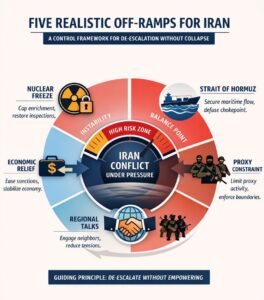
This is not a static conflict. It is a pressure system approaching its limits. Recent developments in late March 2026, including heightened regional alert levels and continued uncertainty around maritime security in the Gulf, reinforce that this pressure is not theoretical—it is actively building.
So the real question is not who wins.
It is:
How do you reduce pressure fast enough to avoid collapse—without forcing surrender?
Each of these off-ramps can also be evaluated against the JaFaJ Denial Doctrine: whether they meaningfully deny Iran the ability to regenerate capability, project power, or impose systemic cost.
- THE NUCLEAR FREEZE: THE SYSTEM STABILIZER
Iran caps enrichment, reduces stockpiles, and restores inspections under the International Atomic Energy Agency. In return, the United States provides phased sanctions relief while Israel reduces direct and covert pressure.
WHAT THIS REALLY DOES
This step compresses escalation risk immediately. Nuclear capability is the fastest-moving variable in the conflict. Left unchecked, it shortens decision timelines for military action and increases the probability of preemptive strikes.
A freeze does three things at once:
- It lengthens breakout timelines
- It reduces justification for immediate military escalation
- It reopens diplomatic and financial channels
WHY THIS HAS WORKED BEFORE
The Joint Comprehensive Plan of Action reduced Iran’s enriched uranium stockpile by approximately 98% and capped enrichment at low levels while preserving domestic infrastructure.¹ That preservation was critical—it allowed Iranian leadership to argue that sovereignty had not been compromised.
CRITICAL WEAKNESS
The failure of the JCPOA created a structural credibility gap. Iran now assumes:
- Agreements are reversible
- Compliance does not guarantee benefit
- Domestic political shifts in adversary states can nullify commitments
This shifts Iran’s negotiating behavior toward:
- Immediate gains over long-term promises
- Reversible concessions over permanent ones
- Skepticism toward verification regimes perceived as asymmetric
JaFaJ POLICY DESIGN
A viable framework must front-load limited economic benefits while preserving leverage. Oil revenues should be released through escrow mechanisms tied to verified compliance milestones. Inspection regimes must be continuous rather than episodic, reducing ambiguity. Enforcement must be automatic and depoliticized, ensuring violations trigger predictable consequences.
- THE STRAIT OF HORMUZ: THE GLOBAL PRESSURE POINT
Iran guarantees maritime stability instead of threatening it.
WHAT THIS REALLY DOES
The Strait is not just a regional chokepoint—it is a global economic trigger. Even minor disruptions ripple through:
- Oil prices
- Shipping insurance markets
- Inflation expectations globally
Short-term disruptions can move oil prices by $5–15 per barrel within days, amplifying economic pressure across multiple economies⁴.
JaFaJ ANALYSIS
Iran’s leverage here is asymmetric but fragile. It relies on credible threat without triggering overwhelming response. The strategic shift is to convert that threat into a conditional service—stability in exchange for economic access.
This reframing changes Iran’s role from:
- System disruptor → system stakeholder
That shift increases durability of leverage.
HISTORICAL ANCHOR
During the Tanker War, attacks on shipping led to U.S. naval intervention and reflagging operations, culminating in direct clashes such as Operation Praying Mantis.³ These interventions constrained Iran’s operational freedom and demonstrated how quickly external actors can dominate the maritime domain.
CRITICAL WEAKNESS
Escalation in this domain invites external control. Once multinational naval forces assume responsibility for security, Iran’s leverage collapses and its actions become constrained by superior force projection.
JaFaJ POLICY DESIGN
A neutral maritime monitoring framework should include regional and non-Western actors to reduce political resistance. Compliance should be measured through verifiable shipping flow metrics, not declarations. Insurance stabilization funds backed by Gulf states can reduce volatility and reinforce incentives. Importantly, sanctions relief should be incremental and reversible, tied directly to sustained stability.
- THE PROXY PROBLEM: MANAGING THE UNMANAGEABLE
Iran constrains proxy activity without dismantling networks such as Hezbollah.
WHAT THIS REALLY MEANS
These networks provide:
- Strategic depth
- Deterrence against direct attack
- Influence across multiple theaters
They are not expendable. They are foundational.
JaFaJ ANALYSIS
Proxy warfare allows Iran to operate below conventional thresholds, but it introduces volatility. The objective is to bound chaos, not eliminate it.
Effective constraint requires:
- Predictability in behavior
- Limits on escalation pathways
- Accountability mechanisms
HISTORICAL ANCHOR
The Dayton Accords imposed territorial and operational constraints on armed actors without dismantling them.⁴ Stability emerged from structured limitation, not disarmament—a key lesson for proxy-heavy conflicts.
CRITICAL WEAKNESS
Decentralized command structures increase the probability of unauthorized escalation. A single incident can cascade into broader conflict if not contained quickly.
JaFaJ POLICY DESIGN
A comprehensive proxy management system should define explicit thresholds for acceptable activity, including geographic limits and weapon types. Monitoring should combine intelligence-sharing and third-party verification. Violations must trigger immediate and predefined responses to maintain credibility. Communication mechanisms between actors should be institutionalized to reduce escalation driven by misinterpretation.
- BACKCHANNEL DIPLOMACY: WHERE REAL PROGRESS HAPPENS
Iran negotiates through intermediaries such as Oman and Qatar.
WHAT THIS REALLY DOES
Backchannels create space for negotiation without public political cost.
JaFaJ ANALYSIS
Public diplomacy is constrained by signaling and domestic audiences. Backchannels allow:
- Exploration of tradeoffs
- Testing of red lines
- Gradual convergence
They function as pressure-release mechanisms within diplomacy itself.
HISTORICAL ANCHOR
Pre-JCPOA negotiations in Oman enabled early agreement on core parameters before formal talks began.⁵ This sequencing reduced public friction and increased the likelihood of success.
CRITICAL WEAKNESS
Backchannels lack institutional durability. They depend on trust between individuals and can collapse rapidly under external pressure or political change.
JaFaJ POLICY DESIGN
A dual-track model should integrate backchannel negotiations with formal diplomatic structures. Timelines must be compressed to maintain momentum. Participation should be limited to trusted actors, and outcomes should be gradually formalized to transition from informal agreements to enforceable frameworks.
- CONTROLLED ATTRITION: THE DEFAULT TRAJECTORY
If no structured off-ramp is implemented, Iran continues a strategy of endurance.
WHAT THIS REALLY IS
A calculated approach based on:
- Political time asymmetry
- Economic pressure distribution
- Strategic patience
JaFaJ ANALYSIS
Iran’s leadership calculates that external coalitions are more vulnerable to political fragmentation than internal structures. This creates an incentive to prolong conflict rather than resolve it quickly.
HISTORICAL ANCHOR
The Iran–Iraq War demonstrated Iran’s capacity to sustain prolonged conflict despite severe losses.⁶ Similarly, modern conflicts have shown that military superiority does not guarantee political outcomes.⁷
CRITICAL WEAKNESS
Attrition erodes capacity over time, including economic resilience and internal cohesion. It is sustainable in the short term but destabilizing in the long term.
JaFaJ POLICY DESIGN
External strategies should focus on targeted pressure that increases marginal costs without triggering systemic escalation. Simultaneously, clear off-ramps must remain visible to incentivize transition away from attrition.
JaFaJ SYNTHESIS: BUILDING A CONTROL SYSTEM
Together, these mechanisms form what can be defined as the JaFaJ Stabilization Framework—a structured approach to reducing systemic pressure without requiring decisive victory or forced capitulation.
A viable off-ramp is not a single agreement. It is a layered control architecture:
LAYER 1 — IMMEDIATE STABILIZATION
Visible military actions and maritime disruptions must be reduced quickly to stabilize global markets and signaling environments.
LAYER 2 — TECHNICAL CONTAINMENT
A nuclear freeze establishes predictability and reduces rapid escalation risk through verifiable constraints.
LAYER 3 — PROXY MANAGEMENT
Proxy activity is bounded through defined operational limits and monitored zones, reducing volatility without dismantling networks.
LAYER 4 — ECONOMIC CALIBRATION
Sanctions relief is phased and conditional, ensuring that compliance produces continuous incentives while preserving leverage.
LAYER 5 — NARRATIVE ALIGNMENT
Each actor must construct a narrative of success. Without this, agreements collapse under internal political pressure regardless of technical strength.
From a policy standpoint, the immediate priority should be the nuclear freeze and maritime stabilization components of this framework. These two elements directly reduce escalation timelines and global economic risk, creating the conditions under which more complex issues—such as proxy management—can be addressed without triggering systemic instability.
FINAL TAKE: CONTROL, NOT RESOLUTION
The objective is not to end the conflict—it is to keep it from exceeding the system’s breaking point.
This conflict will not resolve cleanly.
It will stabilize.
The Iran–Iraq War institutionalized exhaustion without resolution.
The Joint Comprehensive Plan of Action managed risk without eliminating it.
That is the model.
And any strategy built on a different expectation is fundamentally flawed.
These off-ramps should be evaluated against the JaFaJ Denial Doctrine outlined in “When Does the United States Win Against Iran?” Each pathway only has strategic value if it contributes to denying Iran the ability to regenerate capability, project power, or impose systemic cost. Without that linkage, de-escalation mechanisms risk stabilizing the conflict without resolving its underlying drivers.
FOOTNOTES
- International Crisis Group, The Iran Nuclear Deal at Five, 2020.
- Lloyd’s of London, War Risk Insurance Reports.
- Cordesman, Anthony H., The Iran-Iraq War and Western Security, CSIS, 1990.
- U.S. Energy Information Administration, Oil Market Impacts of Strait Disruptions, 2023.
- Parsi, Trita, Losing an Enemy, Yale University Press, 2017.
- Hiro, Dilip, The Longest War, Routledge, 1991.
- Biddle, Stephen, Military Power, Princeton University Press, 2004.
- Jervis, Robert, “Cooperation Under the Security Dilemma,” World Politics, 1978.