ODDS, FAVORITES, AND LONG SHOTS IN THE NEXT WAVE OF NORMALIZATION
EXECUTIVE SUMMARY
Strip away diplomacy and a clearer reality emerges: this is a market. States are pricing risk, capital access, and security alignment. The Abraham Accords now function as a geopolitical index.
MODEL METHODOLOGY
Weighted variables:
– Economic Pressure (30%)
– Security Realignment (25%)
– Political Feasibility (20%)
– External Incentives (15%)
– Timing Risk (10%)
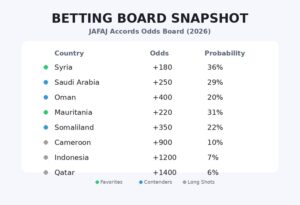
BETTING BOARD SNAPSHOT
| Country | Odds | Implied Probability |
| Syria | +180 | 36% |
| Saudi Arabia | +250 | 29% |
| Oman | +400 | 20% |
| Mauritania | +220 | 31% |
| Somaliland | +350 | 22% |
| Cameroon | +900 | 10% |
| Indonesia | +1200 | 7% |
| Qatar | +1400 | 6%
|
PROBABILITY DISTRIBUTION
THE HARD TRUTH
This is no longer a diplomatic process.
It is a competitive alignment system driven by capital flows, security guarantees, and technological integration.
States are not asking whether normalization is desirable.
They are asking whether non-alignment is still viable.
The underlying shift is structural:
- Capital is no longer neutral — it flows through aligned systems
- Security is no longer regional — it is increasingly networked and conditional
- Technology is no longer optional — it creates long-term dependency once adopted
In this environment, the Abraham Accords function less as agreements and more as an access point into an emerging geopolitical architecture.
THE TIMING DIVIDE
The most important distinction is no longer between participants and non-participants—it is between early, late, and excluded actors.
- Early entrants secure preferential access to capital, infrastructure, and strategic partnerships
- Late entrants face higher costs, reduced leverage, and pre-defined terms
- Non-participants risk systemic exclusion from trade corridors, investment pipelines, and security networks
This creates a compounding effect:
The earlier a state aligns, the more embedded—and advantaged—it becomes over time.
THE POWER REALITY
Despite the language of cooperation, this system is not evenly distributed.
It is shaped by a concentrated power structure:
- The United States defines the security and sanctions environment
- The Gulf states control liquidity and large-scale investment flows
- Israel provides technological and intelligence integration
Entry into the Accords is therefore not a symbolic act—it is a negotiated entry into a controlled system.
And like any system, access is conditional.
THE STRATEGIC CONSEQUENCE
The long-term implication is unavoidable:
Alignment will increasingly be less about sovereignty—and more about structured dependency within dominant networks.
States that integrate early will help define the rules.
States that hesitate will inherit them.
States that remain outside will be forced to operate around them—at a disadvantage.
FINAL THOUGHTS
This is not about peace, it’s not even primarily about normalization.
It is about who gains entry into the next regional economic and security architecture—and under what terms.
The Abraham Accords are no longer a diplomatic initiative.
They are a sorting mechanism.
And in that system, timing is not just important—it is decisive.