WHY THE AGREEMENT MAY ACCIDENTALLY CREATE THE MOST
IMPORTANT SPACE POWER OF THE NEXT DECADE
Executive Summary —– US Legislation —– UN Legislation —– Iran’s Space Program
By JaFaJ Intelligence Services
Classification: Strategic Foresight / Legislative Intelligence Brief
A U.S.–Iran nuclear agreement will not reduce Iranian strategic capability—it will reallocate it into space-enabled, data-driven warfare systems. This shift accelerates Iran’s transition from a constrained nuclear actor into an integrated systems actor capable of persistent, asymmetric regional influence. The primary policy risk is no longer nuclear breakout. It is system integration.
EXECUTIVE THESIS: CONSTRAINT AS CONVERSION — HOW NUCLEAR LIMITS REDIRECT POWER INTO INTEGRATED SYSTEMS
IMPLICATIONS FOR U.S. POLICY
- Constraint does not equal containment. Limiting Iran’s nuclear program may accelerate its transition into integrated aerospace and data-driven systems.
- Time is the critical variable. The strategic window for influencing system development closes once integration thresholds are reached.
- Microelectronics access is the primary leverage point. Control over advanced components directly determines the ceiling of Iran’s system integration capability.
- Detection is no longer sufficient. Monitoring must be paired with disruption or denial strategies to prevent system maturation.
- The risk is diffusion, not concentration. Space-enabled capability may extend to non-state actors, reducing traditional barriers to advanced operational effectiveness.
Iran’s nuclear constraint is being misinterpreted as capability reduction. It is more accurately understood as capability redistribution.
Under a sustained agreement, financial, scientific, and industrial resources previously allocated to nuclear development do not disappear—they shift into domains that are less visible, more scalable, and more operationally immediate.
Open-source defense estimates place Iran’s annual defense and security expenditure at approximately $20–25 billion, with a meaningful share historically allocated to nuclear development, missile systems, and associated research infrastructure. Even partial reallocation—on the order of $3–5 billion annually—creates a sustained funding stream for adjacent high-technology sectors, including satellite systems, launch capability, and integrated drone architectures.
At current cost structures, this level of funding is not marginal—it is transformational.
- ISR-capable satellites can be deployed at $5–50 million per unit
- Domestic launch costs are significantly lower than Western equivalents
- Loitering munitions operate at $20,000–$50,000 per unit
This level of reallocation translates directly into deployable capacity.
Modeled over a five-year period, a sustained reallocation at this level would support:
- 40–120 low Earth orbit satellites, depending on configuration and payload class
• 50–100 launch attempts, accelerating reliability curves toward operational thresholds
• 5,000–15,000 additional drone systems integrated into networked targeting architectures
At this scale, capability shifts from experimental to persistent. The system no longer depends on individual platforms—it operates as a continuous, replenishing architecture.
The constraint is not technological feasibility.
It is allocation discipline.
This creates a structural shift:
A constrained nuclear program does not reduce strategic capability—it reconfigures it into a distributed, persistent, and scalable system.
Historically, nuclear programs have functioned as incubators for aerospace capability. The United States, the Soviet Union, and China all leveraged nuclear-era research into missile and space systems. Iran follows the same pathway: advancements in materials science, propulsion modeling, and precision engineering directly translate into launch and orbital capability.
The outcome is not theoretical.
It is directional and already observable.
A constrained nuclear Iran is not a reduced-threat actor.
It is a reconfigured systems actor—positioned to integrate space, data, and strike capability into a continuous operational architecture.
- THE FALSE SEPARATION: NUCLEAR, MISSILE, AND SPACE SYSTEMS AS A SINGLE PIPELINE
Nuclear, missile, and space systems do not operate as separate domains. They function as a single technological pipeline. The distinction between them is analytical—not technical.
At the engineering level, the overlap is direct. Propulsion, guidance, structural integrity, and multi-phase flight control are shared across all three domains. As the Missile Technology Control Regime notes, space launch vehicle technologies are “virtually identical” to ballistic missile technologies.³
The difference is not system design. It is performance threshold. Orbital systems require higher velocity and greater precision—but they are built on the same underlying architecture.
Iran’s existing launch systems demonstrate that this pipeline is already operational. The progression from missile capability to space launch is not a parallel development. It is a continuation of the same system.
At the engineering level, the overlap is direct. As the Missile Technology Control Regime notes, space launch vehicle technologies are “virtually identical” to ballistic missile technologies.³ Propulsion, guidance, structural integrity, and multi-phase flight control are shared requirements across all three domains.
The difference is not system design.
It is performance threshold.
At the engineering level, the distinction is minimal. Both systems require propulsion stability, structural integrity, and guidance precision across multi-phase flight profiles. The difference is performance threshold, not underlying technology—orbital systems require higher velocity (approximately 7.8 km/s).⁴
Iran’s existing launch systems already demonstrate that this pipeline is operational—not theoretical.
The Simorgh launch vehicle, derived from clustered ballistic missile engine architecture, has demonstrated the ability to place payloads into low Earth orbit. This is not a parallel development to missile capability—it is a direct extension of it.
The Zuljanah rocket further reinforces this convergence. Its use of solid-fuel stages reflects a transition toward rapid-launch capability, reduced preparation time, and increased operational responsiveness—characteristics consistent with modern missile doctrine rather than purely civilian space development.
These systems do not represent separate programs evolving independently.
They are iterative steps within a unified development pathway.
The distinction is visibility, not overlap. Space launches are observable through global tracking systems, while missile development can remain partially concealed.
This produces a structural tension: expanding Iran’s space program increases both its capability and the world’s ability to monitor it.
- IRAN’S REAL CAPABILITY: PRODUCTION, SCALE, AND CURRENT ASSETS
Iran’s aerospace and military capabilities are frequently underestimated due to comparison with Western systems optimized for precision and technological superiority. A more accurate assessment requires evaluating production capacity, scalability, and operational design.
Iran produces ballistic missiles at industrial scale across multiple classes, including systems such as the Shahab-3 and Khorramshahr, with ranges between approximately 2,000 and 3,500 kilometers.⁷ These systems demonstrate sustained propulsion capability and guidance stability over extended distances.
Open-source defense assessments indicate that Iran’s missile production capacity is best understood as a scalable industrial output rather than a fixed inventory. Estimates typically range between 200 and 600 ballistic missiles annually across short- and medium-range systems, depending on configuration and component availability.¹ While precise figures vary, the consistency of these estimates across multiple sources suggests a moderate-to-high confidence range.
This production model reflects a deliberate strategic design philosophy:
- modular assembly
• reduced reliance on highly specialized components
• rapid replication under constrained conditions
The result is a system optimized not for precision per unit, but for aggregate volume, replenishment speed, and sustained operational pressure.
This same logic applies—more significantly—to drone production. Current intelligence and defense analyses estimate that Iran produces several thousand unmanned aerial systems annually, with loitering munitions such as the Shahed-136 accounting for production in the high hundreds to low thousands per year.²
At an estimated unit cost of $20,000–$50,000, these systems enable large-scale deployment at a fraction of the cost of Western platforms.³ This cost asymmetry allows Iran to absorb losses, iterate designs, and maintain persistent operational tempo.
The strategic implication is not incremental—it is structural.
Iran is not optimizing for platform superiority.
It is optimizing for system persistence under attrition.
This model accepts loss at the unit level in exchange for sustained operational pressure at the system level. Precision becomes secondary to volume, and survivability shifts from individual platforms to the network as a whole.
The result is a force design built to absorb degradation, iterate rapidly, and maintain continuous operational tempo—rather than achieve dominance through superior individual systems.
In parallel, Iran has demonstrated independent orbital capability through satellite programs such as the Noor series, launched by the Islamic Revolutionary Guard Corps.⁹ While limited in payload and sophistication, these systems confirm:
- independent launch capability
• basic ISR (intelligence, surveillance, reconnaissance) functionality
• orbital persistence
Iran has also pursued limited cooperation with Russia and indirect technological pathways involving China, suggesting potential for future scaling through external inputs and component access.¹⁰
Iran does not match leading space powers—but it has achieved independent, scalable capability under constraint.
STRATEGIC SPILLOVER: THE RISK OF SATELLITE-ENABLED PROXIES
The primary risk is not the expansion of Iranian capability.
It is the distribution of that capability.
Not nuclear proliferation.
Not conventional weapons proliferation.
But data-enabled lethality proliferation.
Iran’s long-established model of power projection through non-state actors—including Hezbollah and Hamas—creates a pathway through which space-enabled capability does not remain centralized. It diffuses. Historically, this model has relied on the transfer of missile systems, drone technology, training, and operational guidance. The integration of space-enabled data into this framework represents a qualitative shift in capability.
At present, non-state actors operate under structural constraints:
• line-of-sight limitations
• incomplete intelligence
• delayed communication cycles
Access—direct or indirect—to satellite-derived data removes these constraints.
Even limited access alters operational capability:
• Drone strikes shift from pre-programmed targeting to adaptive targeting in real time
• Missile systems reduce circular error probability through updated guidance inputs
• Maritime attacks become timing-optimized rather than opportunistic
This transformation does not require satellite ownership. It can be achieved through:
• shared data pipelines
• proxy access to state-controlled systems
• integration with ground-based relay networks
The result is not the emergence of non-state “space powers,” but the creation of space-enabled actors—entities that can leverage orbital data without controlling the infrastructure that produces it.
The implications are structural.
A drone operating on fixed coordinates is limited. A drone receiving continuous targeting updates operates within a dynamic battlespace, adapting in real time to movement, defenses, and environmental conditions. Missile systems, similarly enhanced, shift from static strike tools to responsive, data-integrated systems.
The concern is not that non-state actors will possess satellites.
It is that they may gain functional access to the advantages satellites provide—without the infrastructure, cost, or visibility traditionally required.
In this scenario, the expansion of Iran’s space capability does not remain contained.
It diffuses.
As diffusion accelerates, the distinction between state and non-state capability begins to erode. Capability becomes defined not by ownership of platforms, but by access to data and the ability to act on it.
At that point, the space race is no longer a competition between nations.
It becomes a distributed system of capability—where power is determined by who can access, process, and operationalize information in real time.
II-A. IRAN’S SPACE PROGRAM: PARTNERS, NUCLEAR LINKAGES, AND TECHNOLOGICAL ARCHITECTURE
Iran’s space capability is not defined by launches.
It is defined by system architecture.
That architecture is built across three interacting layers:
• external inputs (partnerships and supply pathways)
• technological infrastructure (launch, satellite, and data systems)
• nuclear-derived scientific and engineering capacity
These layers do not operate independently.
They form a constrained but scalable system capable of accelerating under favorable conditions.
- INTERNATIONAL PARTNERSHIPS AND EXTERNAL INPUTS
Iran’s space program has developed under constraint, but not in isolation. Its progress reflects a hybrid model combining domestic production with selective external support.
Russia has been the most significant partner. It launched Iran’s first satellite (Sina-1) and later supported the deployment of the Khayyam satellite, which provides higher-resolution earth observation capability than Iran’s indigenous systems. Russian cooperation has likely contributed to:
- satellite bus design improvements
- imaging payload development
- ground control operations
China has played a more indirect but strategically important role. While formal cooperation is limited in public reporting, Chinese commercial ecosystems and dual-use supply chains provide potential pathways for:
- microelectronics acquisition
- communication components
- manufacturing inputs
Multilateral frameworks, including participation in regional space organizations, provide Iran with:
- technical knowledge exchange
- training opportunities
- limited access to international research
The strategic implication is that Iran’s program is not purely indigenous.
GOALS AND STRUCTURAL TRAJECTORY
Iran’s space program is not limited to incremental satellite launches. It is guided by a defined set of long-term objectives that shape investment, infrastructure, and technological development.
These goals include:
- Establishing a persistent low Earth orbit (LEO) presence through a constellation of small satellites capable of continuous regional coverage. This enables sustained surveillance, communication redundancy, and real-time data acquisition across military and economic domains.
- Achieving geostationary orbit (GEO) capability at approximately 36,000 kilometers altitude. GEO systems would allow Iran to maintain continuous coverage over the Middle East, supporting telecommunications, command-and-control systems, and strategic coordination. This represents a major capability leap requiring significantly more powerful launch systems.
- Expanding launch frequency through infrastructure development, including facilities such as the Chabahar Space Center. Increased launch cadence is critical for reducing iteration time, improving reliability, and enabling rapid satellite replenishment.
- Developing independent communications and observation systems to reduce reliance on foreign satellite networks, particularly for military and government use.
- Pursuing long-term human spaceflight capability, which—while not immediately operationally relevant—serves as a proxy indicator of technological maturity across propulsion, life support, and systems integration.
These goals indicate that Iran’s program is not reactive or symbolic. It is structured around achieving strategic autonomy in space-based infrastructure over the next decade.
It is a constrained networked system, capable of scaling through selective external inputs when conditions allow.
- NUCLEAR PROGRAM LINKAGES TO SPACE DEVELOPMENT
The relationship between nuclear capability and space capability is structural, not incidental.
Iran’s nuclear program contributes to aerospace development in several key areas:
- Materials science: high-temperature alloys, composite materials, and structural integrity for reentry and propulsion systems
- High-energy physics: modeling of energy transfer, propulsion efficiency, and thermal management
- Precision engineering: required for both centrifuge systems and guidance/control mechanisms
These shared domains create a technological pipeline in which advancements in nuclear research indirectly strengthen space launch capability.
Use of Nuclear Material in Space Systems
There is no credible evidence that Iran currently deploys nuclear material in its space program.
However, at a theoretical level, nuclear technologies have established applications in space systems:
- Radioisotope Thermoelectric Generators (RTGs)
Used by major space powers to provide long-duration power for satellites and deep-space missions - Nuclear propulsion concepts
Including nuclear thermal propulsion, which significantly increases efficiency for long-duration missions - High-density energy systems
Providing sustained power for advanced onboard processing or long-duration ISR platforms
Iran is not assessed to currently possess deployable versions of these systems. However, its nuclear research base contributes indirectly to the scientific and engineering competencies required to develop them over time.
The more immediate relevance is not nuclear material in orbit, but nuclear-derived knowledge accelerating aerospace capability.
- CORE TECHNOLOGICAL REQUIREMENTS
Iran’s ability to transition from limited space capability to a fully integrated system depends on several critical technological domains.
- LAUNCH SYSTEMS
Requirements:
- multi-stage propulsion systems
- liquid and solid fuel integration
- guidance and stabilization systems
- launch infrastructure and telemetry
Current status:
- functional low Earth orbit capability
- limited payload capacity (~50–300 kg range)
- improving reliability but not yet at high-frequency launch cadence
- SATELLITE SYSTEMS
Key components:
- Satellite Bus (Platform)
- structural frame
- power systems (solar arrays, batteries)
- thermal control
- onboard computing
- Payload Systems
- electro-optical imaging sensors
- communication transponders
- signal intelligence (SIGINT) capabilities (limited but developing)
- Orbital Control
- propulsion modules
- maneuvering capability
- station-keeping
Current Iranian systems are assessed to provide:
- low-resolution ISR capability
- basic communication support
- limited orbital maneuverability
- DATA AND PROCESSING ARCHITECTURE
This is the most critical and most constrained domain.
Requirements:
- onboard processors
- ground-based data centers
- secure communication links
- real-time data fusion systems
Primary constraint:
- access to advanced microelectronics
Without high-performance chips, Iran’s ability to:
- process data in real time
- integrate systems at scale
- support autonomous operations remains limited.
This is the central bottleneck in system integration.
- COMMUNICATION NETWORKS
Requirements:
- satellite-to-ground communication
- encrypted data transmission
- integration with military command systems
These networks enable:
- real-time coordination
- remote drone operation
- dynamic targeting updates
- DRONE AND MISSILE INTEGRATION LAYER
The final operational layer connects space capability to action.
Requirements:
- GPS or alternative navigation systems
- targeting software
- communication relays
- adaptive control systems
This layer converts: data → decision → execution
- OPERATIONAL APPLICATIONS (SYSTEM FUNCTION)
When integrated, Iran’s space capability enables several real-world functions:
- MARITIME DOMAIN AWARENESS
- tracking oil tankers in the Strait of Hormuz
- identifying chokepoints and congestion
- monitoring naval deployments
- TARGETING ENHANCEMENT
- improved missile accuracy
- real-time drone targeting updates
- reduced error margins
- PROXY ENABLEMENT
- indirect provision of targeting data
- enhanced operational coordination
- expansion of non-state actor capability
- ECONOMIC LEVERAGE
- selective disruption of trade routes
- influence over shipping patterns
- increased cost imposition without full conflict
- STRATEGIC CONCLUSION
Iran’s space program should not be evaluated based on satellite count or launch capacity alone.
Its significance lies in its position within a broader system:
- nuclear-derived knowledge base
- scalable missile and drone production
- emerging satellite capability
- potential access to external inputs
When combined, these elements form a constrained but scalable architecture capable of integrating into the modern system of power defined by: Detection → Data → Decision → Action.
The critical threshold is not technological parity with leading space powers.
It is functional integration.
Once achieved, even limited space capability becomes operationally decisive.
III. COMPETITIVE POSITIONING: WHERE IRAN FITS IN THE SPACE ECONOMY
The global space environment is not a single competition.
It is a tiered system in which actors pursue fundamentally different models of power.
The current landscape is defined by three distinct operational models:
- Scale-driven systems, led by commercial actors such as SpaceX, which prioritize launch frequency, payload capacity, and cost reduction through reusable launch vehicles.
- State-dominant systems, developed by countries such as China and Russia, which emphasize sovereignty, military integration, and long-term infrastructure development.
- Integration-driven systems, where the objective is not dominance in launch volume, but the ability to connect satellites, data, drones, and strike capabilities into a unified operational architecture.
Iran does not compete in the first two categories, it does not possess the industrial scale of commercial launch providers, nor the financial depth of major state space programs.
Instead, Iran is developing within the third category—an integration-driven model where the value of space capability is measured not by how much can be launched, but by how effectively orbital data is converted into operational outcomes.
This distinction defines how Iran generates impact despite limited scale.
Commercial actors reduce the cost of access to space.
State powers build infrastructure at scale.
Iran seeks to maximize the operational impact of limited space assets.
A small number of satellites, when combined with:
- large-scale drone production
- missile systems
- ground-based intelligence
- adaptive command structures can produce effects that are disproportionate to the size of the space program itself.
This is a model of asymmetry rather than parity.
If Iran achieves reliable access to orbit, modest ISR capability, and effective integration with its existing systems, it can function as a mid-tier space actor with outsized regional influence.
The space race is no longer determined solely by launch volume. It is defined by how effectively actors convert orbital access into operational advantage.
III. EXPANSION PATHWAYS: HOW THE DEAL ACCELERATES CAPABILITY
A U.S.–Iran agreement does not create new capability.
It accelerates existing capability along three reinforcing pathways.
These pathways should be understood not as independent developments, but as a compounding system: Reliability → Frequency → Integration
Each stage increases the effectiveness of the next.
- RELIABILITY: FROM EXPERIMENTAL TO OPERATIONAL
Iran’s launch systems have historically demonstrated inconsistent success rates, with open-source estimates often placing reliability below 50% in early development phases.¹¹
However, each launch—successful or failed—generates telemetry data that improves propulsion modeling, structural integrity, and guidance systems.
Reliability is not a static condition. It is a learning curve.
Once reliability approaches operational thresholds (typically above 80%), the system transitions from experimentation to deployment.
At that point, launches are no longer tests.
They are infrastructure.
- FREQUENCY: ACCELERATING THE DEVELOPMENT CYCLE
Current Iranian launch activity remains limited, generally in the single digits annually.
By comparison, major space actors operate at significantly higher cadence:
- SpaceX: approximately 90 launches per year
- China: approximately 60 launches per year¹²
Even a modest increase—to 10–15 launches annually—would have disproportionate impact.
Higher launch frequency produces:
- faster iteration cycles
• increased engineering feedback
• reduced time between system improvements
The result is accelerated capability development, even without technological breakthroughs.
Frequency compresses time.
Even modest increases in launch cadence can produce measurable system effects. Moving from low single-digit launches annually to a range of 10–15 launches per year can reduce development iteration cycles by more than 50%, accelerating reliability gains and shortening the transition from experimental to operational capability.
- INTEGRATION: FROM CAPABILITY TO SYSTEM
Integration is the decisive phase.
At this stage, individual capabilities—satellites, drones, and missile systems—are no longer evaluated independently. They are linked into a unified operational architecture.
This integration connects:
- satellites (persistent detection and surveillance)
• data systems (processing and decision-making)
• drones and missiles (execution)
The result is a continuous operational loop in which detection, decision, and action occur in near real time.
At this point, capability becomes systemic rather than additive.
SYSTEM EFFECT: COMPOUNDING CAPABILITY
These three pathways do not operate in isolation.
Improved reliability enables increased launch frequency.
Increased frequency accelerates integration.
Integration amplifies the value of both.
The result is nonlinear capability growth.
A system that initially appears limited can transition rapidly into an operational architecture capable of persistent surveillance, adaptive response, and real-time execution.
Once integration is achieved, the system no longer improves linearly. It compounds—reducing response time, increasing operational tempo, and compressing the decision advantage of adversaries simultaneously. At this stage, marginal improvements in any component produce disproportionate system-wide effects.
STRATEGIC IMPLICATION
The agreement does not simply allow Iran to improve incrementally.
It allows Iran to move along a compounding curve.
Once integration is achieved, marginal improvements in any single component—launch reliability, satellite capability, or drone coordination—enhance the performance of the entire system.
This is the inflection point.
Capability is no longer measured by individual systems.
It is measured by the speed and coherence of the system as a whole.
III-A. LIMITING FACTORS AND FAILURE PATHWAYS: CONSTRAINTS ON SYSTEM ACCELERATION
The trajectory outlined in this report is not inevitable. It is conditional.
These constraints are not equal in impact.
They form a hierarchy of influence over system development:
- Primary constraint: microelectronics access (determines system integration ceiling)
• Secondary constraint: launch reliability (determines persistence and replenishment)
• Tertiary constraints: organizational integration and external disruption (determine speed and stability of development)
The trajectory of Iran’s system is therefore not determined by capability alone, but by which constraints are overcome—and in what sequence.
Several structural constraints could slow, distort, or prevent the full integration of aerospace, data, and operational systems described in preceding sections.
These constraints should be understood not as binary barriers, but as friction points that affect the speed, scale, and coherence of system development.
- MICROELECTRONICS AND COMPONENT ACCESS
The most significant constraint on Iran’s system integration is access to advanced microelectronics, including:
- guidance systems
- secure communication modules
- onboard processing hardware
- radiation-hardened satellite components
While Iran has demonstrated the ability to operate under sanctions through substitution and indirect procurement pathways, high-performance systems remain dependent on components that are difficult to replicate domestically at scale.
Sustained restriction in this domain would:
- limit satellite capability and lifespan
- constrain real-time data processing
- reduce the effectiveness of integrated drone coordination
This represents the primary bottleneck in transitioning from functional capability to high-performance system integration.
- LAUNCH RELIABILITY AND INFRASTRUCTURE LIMITATIONS
Iran’s launch systems remain in a developmental phase, with historically inconsistent success rates.
Without achieving sustained reliability thresholds (typically above 80%), the system cannot transition fully from:
- experimental capability
to - operational infrastructure
Failure to improve reliability would result in:
- limited orbital persistence
- reduced satellite replenishment capacity
- slower iteration cycles
This would delay integration and reduce system resilience.
- ORGANIZATIONAL AND INTEGRATION COMPLEXITY
The transition from individual capabilities to an integrated operational architecture requires:
- coordination across military branches
- real-time data fusion systems
- command-and-control restructuring
- software integration at scale
These are not purely technical challenges. They are organizational.
Historical evidence across multiple countries suggests that integration failures often arise from:
- institutional fragmentation
- bureaucratic competition
- incompatible systems architecture
If these factors persist, Iran’s capabilities may remain parallel rather than integrated, significantly reducing system effectiveness.
- EXTERNAL DISRUPTION AND PREEMPTIVE ACTION
Iran’s trajectory does not occur in isolation.
External actors—including the United States, Israel, and regional partners—retain the capability to:
- disrupt supply chains
- target infrastructure
- degrade launch capability
- interfere with data networks
Preemptive or ongoing disruption could:
- increase development costs
- reduce operational reliability
- delay integration timelines
This introduces strategic uncertainty into the acceleration pathway.
- RESOURCE COMPETITION AND INTERNAL PRIORITIES
The reallocation of resources from nuclear development to aerospace systems assumes:
- sustained funding
- political prioritization
- internal stability
However, competing demands—including:
- domestic economic pressure
- proxy operations
- internal security requirements may divert resources away from long-term system development.
This would slow the transition from capability accumulation to system integration.
III-B. COUNTERARGUMENT: WHY THIS TRAJECTORY MAY FAIL
A competing assessment suggests that Iran may fail to achieve full system integration due to structural constraints. These include persistent microelectronics limitations, organizational fragmentation across military and intelligence bodies, and the technical complexity of real-time data fusion at scale.
Historical precedent indicates that integration failures—rather than technological gaps—are often the primary barrier to system-level capability.
However, this assessment underestimates two factors:
- Iran’s demonstrated ability to operate under constraint through substitution and adaptation
- The reduced threshold required for functional integration in modern systems
Full-spectrum integration is not required to generate strategic impact. Partial integration—particularly in targeting, communication, and drone coordination—is sufficient to alter regional operational dynamics.
CONDITIONAL CONCLUSION
These constraints do not negate the trajectory described in this report, they shape it. The most likely outcome is not uniform acceleration, but uneven development, in which:
- certain capabilities (e.g., drones) scale rapidly
- others (e.g., advanced satellite systems) lag behind
However, even partial integration—particularly at the level of data-enabled targeting and coordination—would be sufficient to produce meaningful strategic impact.
The critical threshold is not full system maturity. Rather, it is functional integration.
Once that threshold is crossed, even under constraint, the dynamics described in this report begin to operate.
- GLOBAL SPACE COMPETITION: WHERE IRAN FITS
The global space environment is no longer defined by a single competitive model.
It has evolved into a tiered system in which different actors optimize for fundamentally different objectives.
This system can be understood across three distinct tiers:
TIER 1: COMMERCIAL SCALE AND FREQUENCY
Tier 1 is dominated by commercial actors such as SpaceX and Blue Origin, which lead in launch frequency, payload capacity, and cost efficiency.
These systems are optimized for:
- high-volume launch cadence
• large payload delivery
• global commercial infrastructure
For example, SpaceX’s Falcon 9 can deliver more than 22,000 kilograms to low Earth orbit and operates at a launch frequency unmatched by most state actors.¹³
The defining characteristic of Tier 1 is scale.
TIER 2: STATE-INTEGRATED STRATEGIC SYSTEMS
Tier 2 is dominated by state-directed programs, most notably China, where space capability is fully integrated into national strategy.
These systems are optimized for:
- long-term strategic positioning
• civil-military integration
• sovereign technological ecosystems
Space capability in this tier is not purely commercial or military—it is a coordinated extension of state power across economic, security, and political domains.
The defining characteristic of Tier 2 is control.
TIER 3: STRATEGIC SOVEREIGNTY AND INTEGRATION
Iran occupies a distinct Tier 3.
It does not compete on payload capacity or launch frequency.
It competes on independence, resilience, and integration with operational systems.
This model is optimized for:
- independent access to orbit
• survivability under constraint
• integration with missile and drone architectures
Iran’s objective is not dominance of space infrastructure.
It is functional integration into a system where space-enabled data enhances real-time operations.
The defining characteristic of Tier 3 is integration under constraint.
STRATEGIC DISTINCTION
Each tier reflects a different theory of power:
- Tier 1: Power through scale
• Tier 2: Power through control
• Tier 3: Power through integration
Iran’s position in Tier 3 makes it fundamentally different from both commercial leaders and state-integrated powers.
It does not need to match their capabilities.
It only needs to integrate effectively within the emerging system.
STRATEGIC IMPLICATION
The risk posed by Iran is not that it will outcompete leading space actors.
The risk is that it will become operationally effective at a lower threshold of capability.
In a system defined by data, speed, and integration, even limited space assets can generate disproportionate impact when connected to scalable drone and missile systems.
This shifts the competitive landscape.
The space race is no longer defined solely by who can launch the most or carry the most.
It is increasingly defined by who can convert space-based data into operational advantage—quickly, reliably, and at scale.
Within that framework, Iran’s model is not inferior.
It is asymmetric.
- UKRAINE CASE STUDY: SPACE AS WARFIGHTING INFRASTRUCTURE
The war in Ukraine provides a real-world demonstration of how space-enabled systems transform military operations from platform-based warfare to integrated, data-driven architectures.
The critical shift is not the use of satellites alone, but their integration into a continuous operational loop linking detection, communication, and execution.
Satellite networks have enabled:
- persistent battlefield communication
• real-time intelligence sharing
• distributed coordination of drone operations
In multiple documented engagements between 2022 and 2024, Ukrainian forces used satellite-enabled communication systems—most notably commercial networks—to maintain operational coordination after conventional infrastructure was degraded.¹⁴
This capability allowed dispersed units to operate as a connected system rather than isolated elements.
The operational impact is measurable.
Drone systems, enabled by real-time data and communication, have been estimated to account for 60–70% of targeting operations in certain sectors.¹⁴ These systems have been used to identify, track, and strike high-value assets, including armored vehicles, at a fraction of the cost of traditional platforms.
This produces a decisive shift in battlefield economics:
Low-cost, data-enabled systems are capable of degrading or destroying high-cost assets.
The significance of this dynamic is not tactical—it is structural.
Satellite connectivity replaces centralized command infrastructure.
Drones become the execution layer of decisions derived from real-time data.
The result is an integrated operational system in which detection, communication, decision-making, and execution occur continuously and at speed.
The technologies involved—commercial satellite access, low-cost drones, and modular communication systems—are not restricted to major powers. They are increasingly accessible to states with limited resources but strong strategic intent.
STRATEGIC RELEVANCE TO IRAN
The relevance to Iran is direct.
Iran’s existing capabilities—low-cost drone production, missile systems, and emerging satellite infrastructure—align closely with the components required to replicate this model.
Iran does not need to match the technological sophistication of leading space powers.
It needs to achieve functional integration across:
- satellite-enabled data acquisition
• drone and missile execution systems
• real-time communication networks
If achieved, this would allow Iran to operate within the same system demonstrated in Ukraine:
A system in which information is converted into action rapidly, continuously, and at scale.
CONCLUSION
The Ukraine conflict does not represent an isolated case.
It represents a working model of how space-enabled systems transform operational effectiveness.
It demonstrates that:
Power is no longer defined by individual platforms.
It is defined by the ability to integrate data, communication, and execution into a continuous operational system.
- RED SEA CASE STUDY: DATA AS ECONOMIC WEAPON
Recent disruptions in the Red Sea provide a clear example of how limited, data-informed actions can generate disproportionate economic impact.
These events are not defined by territorial control or sustained naval dominance.
They are defined by the ability to selectively disrupt critical flows using targeted, information-driven operations.
The measurable effects are significant:
- shipping costs increased by approximately 200–300%
• transit delays extended by 10–14 days
• insurance premiums rose sharply across affected routes¹⁵
These outcomes were not the result of large-scale military engagement.
They were the result of targeted disruptions applied at critical points within a globally interconnected system.
MECHANISM: SELECTIVE DISRUPTION
The key mechanism is not volume of force, but precision of application.
Data—particularly maritime awareness, route tracking, and timing—enables actors to:
- identify high-value targets within shipping lanes
• exploit congestion points and chokepoints
• apply disruption at moments of maximum economic sensitivity
This transforms disruption from a blunt instrument into a calibrated tool.
Rather than halting trade entirely, limited actions can:
- force rerouting decisions
• increase operational uncertainty
• drive cascading cost increases across global supply chains
SYSTEM-LEVEL EFFECT
This model reflects the same integrated architecture identified throughout this report: Detection → Data → Decision → Action
When applied to global trade systems, this loop produces economic effects rather than purely military ones.
The significance lies in how small, precisely applied actions propagate through a system to produce disproportionate consequences.
STRATEGIC RELEVANCE TO IRAN
The relevance to Iran is direct.
Iran’s geographic position, combined with its expanding aerospace and data capabilities, places it near one of the most critical nodes in global energy and trade: the Strait of Hormuz.
If Iran integrates:
- satellite-based maritime surveillance
• drone and missile targeting systems
• real-time data processing
it could apply the same model at significantly greater scale.
Unlike the Red Sea, the Strait of Hormuz carries approximately one-fifth of global petroleum flows.¹⁸
Even limited, data-driven disruptions in this environment would have outsized global impact.
CONCLUSION
The Red Sea case demonstrates that economic influence no longer requires sustained control over territory or trade routes.
It requires the ability to observe, interpret, and selectively disrupt a system.
This creates a structural shift a shift from physical dominance to informational leverage.
Within that framework, space-enabled data is not supportive.
It is decisive.
VII. ISRAEL CASE STUDY: DATA-DRIVEN DEFENSE
Israel’s missile defense systems provide a clear example of how modern defense capability is fundamentally dependent on data integration rather than standalone intercept technology.
Reported interception rates—often cited in the range of 85–90% for certain categories of incoming threats—are not solely a function of interceptor performance.¹⁶
They are the result of a fully integrated detection, tracking, and response architecture.
This system relies on:
- early warning and detection (radar and satellite-supported inputs)
• real-time data processing and threat classification
• coordinated interceptor deployment across multiple layers
The effectiveness of the system depends on the speed and accuracy with which data is collected, processed, and translated into action.
MECHANISM: DEFENSE AS A DATA LOOP
Israel’s missile defense architecture operates within the same system model identified throughout this report: Detection → Data → Decision → Interception
Incoming threats are detected, tracked, and evaluated in real time.
Interception decisions are generated rapidly based on trajectory, threat level, and projected impact.
This process occurs within seconds. The result is not simply interception: It is system performance.
SYSTEM-LEVEL INSIGHT
Defensive capability is no longer defined primarily by the quality of individual interceptors.
It is defined by the performance of the system as a whole.
A highly capable interceptor without real-time data integration is limited.
A fully integrated system can achieve high effectiveness even against large volumes of incoming threats.
STRATEGIC RELEVANCE TO IRAN
The relevance to Iran is structural.
If Iran successfully integrates satellite-enabled detection, real-time data processing, and coordinated strike systems, it is effectively building the offensive counterpart to this model.
Where Israel’s system converts data into interception, Iran’s emerging architecture could convert data into strike execution.
The underlying system is the same.
Only the function differs.
CONCLUSION
The Israel case demonstrates that modern defense systems are fundamentally data systems.
Effectiveness is determined not by individual platforms, but by the ability to integrate detection, processing, and response into a continuous operational loop.
This reinforces a central conclusion of this report:
In modern conflict, data is not a supporting element.
It is the core of operational power.
VIII. THE DRONE REVOLUTION: SCALE, COST, AND SYSTEM EFFECT
Iran’s drone production model represents a fundamental shift in modern military capability, defined not by technological sophistication alone, but by scale, cost efficiency, and system integration.
Current intelligence and defense analyses estimate that Iran produces between 1,000 and 5,000 unmanned aerial systems annually, depending on model type and operational demand.¹⁷ Within this range, loitering munitions such as the Shahed-136 account for production in the high hundreds to low thousands per year.¹⁸
At an estimated unit cost of $20,000–$50,000, these systems enable large-scale deployment at minimal marginal cost.
COMPARATIVE COST STRUCTURE
This production model contrasts sharply with Western and allied systems:
- United States (MQ-9 Reaper): approximately $30 million per unit
• Turkey (Bayraktar TB2): approximately $5 million per unit
• Iran (Shahed-136): $20,000–$50,000 per unit
This disparity creates a structural cost asymmetry.
Systems costing tens of thousands of dollars can be used to degrade or destroy assets valued in the millions.
MECHANISM: ECONOMIC WARFARE THROUGH SCALE
The strategic significance is not the drone itself.
It is the combination of:
- low-cost production
• high-volume deployment
• integration with targeting and data systems
When integrated into a broader architecture—supported by satellite-derived data and real-time communication—these systems become force multipliers.
A single drone is limited.
A network of low-cost drones, operating with updated targeting data, becomes a persistent, adaptive system capable of overwhelming defenses and imposing continuous cost on an adversary.
CONSTRAINT AND EXPANSION
The primary constraint on this model is not airframe production.
It is access to microelectronics, including:
- navigation systems
• communication modules
• onboard processing components
If access to these components improves—through sanctions relief or indirect supply pathways—production capacity and system integration could expand significantly.¹⁰
This expansion would not be linear.
It would be exponential, as software-enabled coordination, including swarm behavior, increases the effectiveness of each additional unit.
STRATEGIC IMPLICATION
Warfare is shifting from platform-based models to network-based systems.
Effectiveness is no longer determined by the capability of individual systems, but by the scale and integration of the network in which they operate.
Within this model, cost efficiency becomes a strategic advantage.
An actor capable of producing large numbers of low-cost, data-enabled systems can impose sustained economic and operational pressure on adversaries with significantly higher-cost platforms.
CONCLUSION
The drone revolution does not simply lower the cost of warfare.
It changes its structure.
When combined with space-enabled data and real-time integration, low-cost systems can generate disproportionate impact.
In this environment, scale, connectivity, and adaptability outweigh technological superiority at the unit level.
- STRAIT OF HORMUZ: FROM CHOKEPOINT TO DATA-DOMINATED SYSTEM
The Strait of Hormuz has historically been understood as a physical chokepoint, with approximately 20–21 million barrels of oil per day transiting the corridor—representing roughly one-fifth of global petroleum consumption.¹⁸
Traditional analysis focuses on physical disruption: blockade, naval conflict, or direct military control.
This framework is increasingly outdated.
The emerging reality is that control over the Strait is shifting from physical dominance to informational dominance.
MECHANISM: FROM BLOCKADE TO SELECTIVE DISRUPTION
Satellite-enabled surveillance and real-time data systems now allow for:
- continuous tracking of tanker movements
• identification of routing patterns and congestion points
• monitoring of naval deployments and escort structures
When integrated with drone and missile systems, this data enables a different form of leverage:
Selective, data-driven disruption.
Rather than attempting to close the Strait entirely—an action that would trigger immediate escalation—an actor can apply targeted pressure by:
- disrupting specific vessels or transit windows
• creating uncertainty in routing decisions
• increasing insurance and operational costs
This approach avoids full-scale confrontation while generating significant economic impact.
SYSTEM EFFECT: DISPROPORTIONATE CONSEQUENCES
The economic impact of limited disruption is nonlinear.
Recent disruptions in the Red Sea have already demonstrated that targeted actions can increase shipping costs by 200–300% and extend transit times by up to two weeks.¹⁵
Applied to the Strait of Hormuz, where global energy flows are significantly higher, even modest disruption would have amplified global consequences.
The system does not require closure.
It requires pressure.
STRATEGIC RELEVANCE TO IRAN
Iran’s geographic position gives it proximity to the Strait.
Its evolving capabilities—satellite systems, drone production, and missile integration—provide the tools necessary to operate within this model.
If integrated effectively, Iran could influence global energy flows not through sustained blockade, but through continuous, data-informed intervention.
This represents a shift from controlling a location to shaping a system.
GLOBAL ADAPTATION
Alternative pathways—such as pipeline routes bypassing the Strait or emerging Arctic shipping corridors—introduce redundancy into the global system.¹⁹
However, these adaptations do not eliminate vulnerability.
They redistribute it across a broader network of routes, each with distinct risks and costs.
In this environment, advantage lies with the actor capable of:
- monitoring multiple pathways in real time
• identifying system vulnerabilities
• applying selective disruption with precision
CONCLUSION
The Strait of Hormuz is no longer defined solely by geography.
It is a node within a global, information-dominant system.
Control is no longer exercised through blockade alone.
It is exercised through the ability to observe, interpret, and selectively disrupt.
Within this framework, space-enabled data is not a supporting capability.
It is the mechanism of control.
- SYSTEM-LEVEL ANALYSIS: THE ARCHITECTURE OF MODERN POWER
The preceding sections do not describe separate domains.
They describe a single system.
Missiles, drones, satellites, trade routes, and regional conflicts are no longer independent variables. They are components of an integrated operational architecture defined by the compression of time, the centrality of data, and the continuous interaction between detection and action.
This architecture operates as a continuous, integrated cycle in which information is collected, processed, and acted upon in near real time, with outcomes immediately informing subsequent actions.
Each stage is now technologically integrated.
- Satellites provide persistent detection and global coverage
• Data systems process information in real time
• Decisions are generated at increasing speed, including through automated systems
• Drones, missiles, and economic actions execute those decisions
• Outcomes are fed back into the system, refining future performance
TIME AS THE PRIMARY VARIABLE
The defining transformation is not capability alone.
It is time.
Historically, the cycle from detection to action could take hours or days. In modern systems, that cycle has been compressed to minutes—and in some cases, seconds.
This compression alters the structure of power.
Power is no longer defined primarily by the size of an arsenal.
It is defined by the speed and accuracy with which information is converted into action.
SYSTEM PERFORMANCE OVER PLATFORM SUPERIORITY
Within this architecture, individual systems matter less than their integration.
A more advanced platform operating in isolation is less effective than a network of coordinated systems operating with real-time data.
The Ukraine conflict demonstrates how integrated drone and satellite systems can offset conventional disadvantages.¹⁴
Red Sea disruptions show how information can generate disproportionate economic impact.¹⁵
Israeli missile defense illustrates that survival depends on real-time data integration.¹⁶
These cases are not independent.
They are the same system operating across different domains.
In Ukraine, it manifests as battlefield coordination.
In the Red Sea, it manifests as economic disruption.
In Israel, it manifests as defensive interception.
The structure is identical:
data is collected, processed, and acted upon in compressed time cycles.
The domain changes.
The system does not.
IRAN’S POSITION WITHIN THE SYSTEM
Iran’s trajectory aligns with this architecture.
It is not attempting to replicate the full-spectrum capabilities of major powers. It is positioning itself to enter the system at key leverage points.
Its advantages include:
- cost-efficient, high-volume drone production
• scalable missile manufacturing
• emerging satellite capability
• a strategic focus on integration rather than technological dominance
The primary constraint remains access to advanced microelectronics. However, even partial improvement in access—through sanctions relief or indirect supply pathways—could significantly accelerate system integration.¹⁰
INFLECTION POINT
Once integration is achieved, marginal improvements in any component—satellite capability, launch reliability, drone coordination—enhance the performance of the entire system.
This creates nonlinear capability growth.
At this point, capability is no longer measured by individual systems.
It is measured by system performance.
CONCLUSION
The global space race is no longer defined by payload capacity, launch frequency, or technological prestige.
It is defined by the ability to integrate space-based data into systems that operate in real time across military, economic, and political domains.
In this environment, the decisive advantage belongs to the actor that can:
- See first.
- Decide faster.
- Act continuously.
This is the architecture of modern power.
- CONCLUSION: THE PARADOX OF VISIBILITY AND POWER
The transformation described in this analysis is not theoretical. It is already underway, and its implications are immediate. A satellite does not simply orbit the Earth—it observes, records, and transmits. A drone does not simply fly—it executes decisions derived from data streams that originate far beyond the battlefield. A missile does not simply strike—it completes a chain of actions that began with detection, processing, and calculation.
In this environment, the U.S.–Iran agreement takes on a different meaning. It is no longer solely a mechanism for constraining nuclear capability. It is a structural intervention that may redirect Iran’s trajectory toward aerospace systems, data integration, and scalable technologies.¹
The reallocation of resources away from nuclear development and toward space and drone systems does not eliminate risk. It redistributes it. Nuclear weapons represent concentrated, catastrophic risk. Integrated aerospace systems represent distributed, continuous risk—less immediately destructive, but more persistent, adaptable, and difficult to deter.
The most consequential outcome of the agreement may be the acceleration of Iran’s entry into a system where actions occur faster than traditional decision-making processes can respond—compressing response cycles into minutes, and in some cases, seconds.
This is not hypothetical. It is a direct extension of capabilities already demonstrated across multiple regions and conflicts.
The paradox at the center of this transformation is unavoidable. A more capable Iran introduces greater operational risk. Yet an isolated Iran, operating without visibility or integration, introduces a different form of risk—one defined by uncertainty, miscalculation, and strategic surprise.
Visibility does not eliminate danger. It reframes it.
A system that can be observed can be analyzed. A system that can be analyzed can, in some cases, be anticipated. A system that operates in isolation, without observable signals, reduces the ability of external actors to respond effectively.
The U.S.–Iran agreement does not resolve this tension. It shifts it.
From nuclear secrecy to orbital visibility.
From static deterrence to dynamic interaction.
From delayed response to real-time consequence.
The strategic question is no longer whether this transition should occur. It is whether it can still be shaped.
If the shift toward integrated, space-enabled systems is already underway, then the U.S.–Iran agreement is not a containment mechanism. It is an acceleration mechanism.
That acceleration creates a narrowing window for response.
Once Iran achieves consistent launch capability, sustained orbital presence, and real-time integration with drone and missile systems, the system becomes self-reinforcing. At that point, disruption becomes more costly, deterrence becomes less predictable, and response timelines compress beyond traditional decision cycles.
The next phase of competition will not be determined by who possesses the most advanced platforms. It will be determined by who can shape, disrupt, or deny integrated systems before they reach operational maturity.
The next conflict will not begin with escalation. It will begin with integration already achieved.
XII. STRATEGIC DECISION MATRIX: POLICY PATHWAYS AND OUTCOMES
The analysis presented in this report leads to a constrained set of strategic options.
These options do not eliminate risk. They redistribute it across different domains and timelines.
The decision space can be understood across three primary policy pathways:
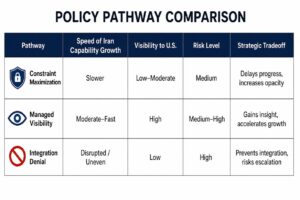
PATHWAY 1: CONSTRAINT MAXIMIZATION (DELAY STRATEGY)
Objective: Slow or prevent system integration
Mechanisms:
• strict enforcement of microelectronics restrictions
• disruption of supply chains
• targeting of launch and data infrastructure
Outcome:
• delays integration timeline
• maintains fragmentation across systems
• preserves longer decision windows
Risk:
• incomplete enforcement leads to partial acceleration
• increased likelihood of covert development pathways
PATHWAY 2: MANAGED VISIBILITY (MONITORING STRATEGY)
Objective: Allow development while maximizing observability
Mechanisms:
• controlled sanctions relief
• expanded monitoring of launches and space assets
• intelligence integration across allied systems
Outcome:
• increased visibility into system development
• earlier detection of integration thresholds
• reduced risk of strategic surprise
Risk:
• accelerates capability under observable conditions
• reduces time available once system matures
PATHWAY 3: INTEGRATION DENIAL (PREEMPTIVE STRATEGY)
Objective: Prevent system-level integration before threshold is reached
Mechanisms:
• cyber disruption of data architecture
• interference with communication networks
• targeted disruption of integration nodes
Outcome:
• prevents transition from capability to system
• maintains separation between domains
Risk:
• escalation potential
• requires precise timing and sustained execution
STRATEGIC TRADEOFF
No pathway eliminates the underlying trajectory.
Each pathway alters:
• speed of development
• visibility of capability
• stability of the system
The central decision is therefore not whether Iran develops integrated capability.
It is whether that capability emerges:
- slowly and visibly
• rapidly and partially concealed
• or in a disrupted and unstable form
None of these pathways prevent the emergence of Iranian integrated capability. They differ only in speed, visibility, and stability. The strategic decision is not whether Iran develops this capability—it is whether that development occurs slowly and observably, rapidly and partially concealed, or under conditions of disruption and escalation.
DECISION THRESHOLD
The window for effective intervention closes once Iran achieves:
• consistent launch reliability
• sustained orbital presence
• real-time integration with drone and missile systems
Beyond this point, the system becomes self-reinforcing and significantly more difficult to degrade.
The strategic objective is not to respond after this threshold.
It is to act before it is reached.
FOOTNOTES
- International Institute for Strategic Studies, Military Balance 2025.
- Walter A. McDougall, The Heavens and the Earth: A Political History of the Space Age (New York: Basic Books, 1985).
- Missile Technology Control Regime, “Equipment, Software and Technology Annex,” http://www.mtcr.info
- NASA, “Basics of Spaceflight,” http://www.nasa.gov
- CSIS Missile Threat Project, “Simorgh,” http://www.missilethreat.csis.org
- CSIS Missile Threat Project, “Zuljanah,” http://www.missilethreat.csis.org
- International Institute for Strategic Studies, Missile Capabilities Report.
- Defense Intelligence Agency, UAV Systems Analysis Reports.
- Iranian Space Agency, “Noor Satellite Program.”
- Stockholm International Peace Research Institute (SIPRI), Technology Transfer Reports.
- CSIS Launch Analysis Data.
- SpaceX Launch Statistics, http://www.spacex.com
- NASA Launch Vehicle Data.
- Royal United Services Institute (RUSI), Ukraine War Analysis Reports.
- Lloyd’s Shipping Intelligence, Red Sea Impact Reports.
- Israeli Ministry of Defense, Missile Defense Data.
- IISS Drone Warfare Reports.
- U.S. Energy Information Administration, http://www.eia.gov
- Arctic Council, Maritime Route Analysis.