JaFaJ
MENA LEGISLATIVE INTELLIGENCE
COUNTRY-BY-COUNTRY LEGISLATIVE INTELLIGENCE
MASTER 9.75 PRODUCTION EDITION
Country-by-Country Legislative Intelligence | MENA
Reporting period: 6–12 September 2026 | Publication date: 13 September 2026
How to Use This Section
This section is designed to replace a thin country list with a usable legislative-intelligence product. Each jurisdiction
contains four elements: verification status, analytical significance, priority legislative watch areas, and collection/next-
stage triggers. Where no current bill or enacted instrument was verified, the section does not invent one. Instead, it
identifies the legal and institutional pressure points that should be monitored in the next reporting cycle.
“No qualifying current legislative action was verified” means that the available source pass did not produce a
sufficiently reliable, specific, and current bill, vote, enacted law, or equivalent legal instrument for detailed inclusion. It
does not mean that the country was inactive.
Executive decisions, cabinet measures, regulatory instruments, international resolutions, and sanctions are included
when they materially affect the legal environment, but they are labeled separately from parliamentary legislation.
Country-by-Country Coverage
ALGERIA
Verification status: No qualifying current legislative action was independently verified after a broader source pass
at the level required for inclusion as a current bill, vote, or enacted instrument.
Algeria remains a major legislative watch jurisdiction because energy policy, hydrocarbons governance, fiscal
management, public investment, and state modernization are closely connected. The absence of a verified current bill
in this reporting pass should not be read as evidence that no legal or regulatory activity occurred. It means that no
item met the report’s inclusion threshold for a specific current legislative action.
Priority Legislative Watch
Energy and hydrocarbons legislation should be monitored for changes affecting licensing, state-company governance,
foreign investment, production-sharing arrangements, export policy, and domestic energy pricing. Fiscal measures
should be tracked for subsidy reform, taxation, public-sector compensation, and budget execution. State-
modernization measures may affect administrative digitization, public procurement, local government, and the
relationship between executive institutions and citizens.
Collection Priorities and Next Trigger
Priority collection: official parliamentary agenda and journal; Presidency and Council of Ministers decisions; Ministry of
Energy and Mines; Ministry of Finance; Official Gazette. Key trigger: publication of a bill, decree, implementing
regulation, or budget measure with direct consequences for hydrocarbons, investment, or fiscal policy.
BAHRAIN
Verification status: No qualifying current parliamentary action was sufficiently verified after a broader source pass.
Bahrain’s legislative significance is concentrated in fiscal sustainability, labor-market regulation, financial services,
digital governance, and internal security. The country’s role as a regional financial center means that regulatory
instruments may be as consequential as formal parliamentary bills.
Priority Legislative Watch
Watch fiscal and tax measures, public-debt management, labor and expatriate employment rules, financial-sector
regulation, cybersecurity, data governance, and legislation affecting public order or security institutions. Particular
JaFaJ | MENA LEGISLATIVE INTELLIGENCE | MASTER 9.75
JaFaJ — Country-by-Country Legislative Intelligence | 6–12 September 2026
attention should be paid to whether new rules impose compliance costs on banks, technology companies, employers,
or civil-society organizations.
Collection Priorities and Next Trigger
Priority collection: Council of Representatives, Shura Council, Official Gazette, Cabinet decisions, Central Bank of
Bahrain, Ministry of Finance and National Economy, and Labour Market Regulatory Authority. Key trigger: a measure
affecting taxation, employment, financial compliance, digital activity, or security powers.
DJIBOUTI
Verification status: No qualifying current legislative action was sufficiently verified.
Although no specific current legislative item met the inclusion threshold, Djibouti remains strategically important
because of its ports, foreign military presence, logistics economy, and exposure to the Bab al-Mandeb maritime
corridor. Legal developments affecting ports, customs, maritime security, foreign basing, infrastructure concessions,
and public debt could have consequences beyond the country’s size.
Priority Legislative Watch
Monitor port and free-zone legislation, customs and transit rules, infrastructure concessions, public-private
partnerships, maritime-security authorities, foreign military agreements, and debt-related fiscal measures. Legislative
changes affecting the port economy may influence regional supply chains and the operating environment for foreign
governments and commercial operators.
Collection Priorities and Next Trigger
Priority collection: National Assembly, Presidency, Council of Ministers, Ministry of Economy and Finance, port
authorities, customs administration, and Official Gazette. Key trigger: any law or executive instrument affecting port
concessions, maritime security, customs, or foreign military access.
EGYPT
Verification status: No qualifying current parliamentary action was sufficiently verified after a broader source pass.
Egypt’s legislative watch remains centered on fiscal reform, investment, energy, Suez Canal policy, public enterprises,
and regional diplomacy. The absence of a verified current parliamentary measure does not reduce the importance of
Egypt’s legal environment; many consequential decisions may emerge through executive regulations, budget
instruments, cabinet decisions, or sector-specific authorities.
Priority Legislative Watch
Track tax and customs changes, privatization and state-asset policy, foreign-exchange and investment rules, energy
pricing, electricity and fuel subsidies, Suez Canal regulations, industrial incentives, and laws affecting public borrowing
or state-owned enterprises. Also monitor legal measures connected to regional security, migration, border
management, and humanitarian access.
Collection Priorities and Next Trigger
Priority collection: House of Representatives, Cabinet, Official Gazette, Ministry of Finance, General Authority for
Investment and Free Zones, Ministry of Petroleum and Mineral Resources, and Suez Canal Authority. Key trigger: a
measure that changes investor obligations, fiscal policy, energy pricing, or canal-related commercial rules.
LIBYA
Verification status: No qualifying current legislative action was sufficiently verified.
Libya’s principal legislative risk is institutional fragmentation between rival centers of authority. A law or decree may
have limited practical effect if the issuing institution lacks territorial reach, administrative capacity, or acceptance by
competing authorities. The key analytical issue is therefore not only what text is adopted, but who recognizes it, who
implements it, and where it applies.
Priority Legislative Watch
Watch budget authorization, central-bank governance, oil revenue allocation, public-sector salaries, election
legislation, security-sector organization, municipal administration, migration policy, and rules governing oil facilities
and infrastructure. Competing legal instruments, parallel appointments, and disputes over jurisdiction may be more
important than formal legislative volume.
JaFaJ | MENA LEGISLATIVE INTELLIGENCE | MASTER 9.75
JaFaJ — Country-by-Country Legislative Intelligence | 6–12 September 2026
Collection Priorities and Next Trigger
Priority collection: House of Representatives, High Council of State, rival executive authorities, Central Bank of Libya,
National Oil Corporation, municipal bodies, and official legal publications. Key trigger: any measure that changes
revenue distribution, election rules, security authority, or control over oil institutions.
MOROCCO
Verification status: No qualifying current parliamentary action was sufficiently verified in this pass.
Morocco remains a priority legislative jurisdiction because investment, tax policy, social protection, water security,
industrial policy, and territorial governance are central to the state’s development agenda. The country should also be
monitored for official responses to Spain’s citizenship measure affecting Sahrawis born under Spanish rule.
Priority Legislative Watch
Track investment and business-law reforms, tax and customs measures, social-protection implementation, water
allocation and infrastructure, industrial incentives, employment regulation, decentralization, and legislation affecting
Western Sahara. Spain’s citizenship measure may generate diplomatic, administrative, or legal responses involving
nationality, documentation, consular practice, and relations with Sahrawi communities.
Collection Priorities and Next Trigger
Priority collection: House of Representatives, House of Councillors, Government Secretariat-General, Official Gazette,
Ministry of Economy and Finance, Ministry of Investment, and relevant ministries responsible for water and social
protection. Key trigger: a bill or implementing decree affecting investment, water, social protection, or Western
Sahara-related legal status.
MAURITANIA
Verification status: No qualifying current legislative action was sufficiently verified.
Mauritania’s legislative watch is shaped by mining, energy, fisheries, investment, border management, and the
emerging importance of offshore resources. The country’s legal framework can affect foreign investors, local
employment, maritime access, revenue distribution, and relations with neighboring states.
Priority Legislative Watch
Monitor mining and petroleum legislation, local-content rules, fisheries access and enforcement, environmental
requirements, public procurement, infrastructure concessions, and investment incentives. Energy-sector laws should
be examined for revenue governance, state participation, transparency, and the distribution of benefits to local
communities.
Collection Priorities and Next Trigger
Priority collection: National Assembly, Council of Ministers, Ministry of Finance, Ministry of Petroleum and Mines,
fisheries authorities, and Official Gazette. Key trigger: a new concession framework, revenue-sharing rule,
environmental requirement, or investment measure.
SUDAN
Verification status: No qualifying current legislative action was sufficiently verified.
Sudan’s legislative capacity remains subordinate to war, territorial fragmentation, humanitarian crisis, and competing
claims to state authority. In this environment, formal legislative output may be limited, displaced by emergency
decrees, military orders, administrative directives, or rival institutional claims.
Priority Legislative Watch
Watch emergency governance, public finance, humanitarian access, banking and currency rules, natural-resource
control, local administration, displacement and nationality documentation, and any legal instrument concerning
ceasefire implementation or transitional governance. Analysts should distinguish between national law, military
directives, regional decrees, and de facto rules imposed by armed actors.
Collection Priorities and Next Trigger
Priority collection: transitional or competing governing bodies, Ministry of Justice, central bank, humanitarian
authorities, regional administrations, and international monitoring organizations. Key trigger: any instrument affecting
humanitarian access, banking, public salaries, resource control, or transitional political arrangements.
JaFaJ | MENA LEGISLATIVE INTELLIGENCE | MASTER 9.75
JaFaJ — Country-by-Country Legislative Intelligence | 6–12 September 2026
TUNISIA
Verification status: Medium-confidence legislative activity.
The Assembly’s official legislative database records basic-law proposal 2026/044 concerning guarantees for
enforcement of judicial judgments and decisions and criminalization of obstruction of their execution. The proposal
was deposited on 24 June 2026, referred on 7 July, and remains listed as before committees.
Priority Legislative Watch
The proposal is important because it addresses the practical authority of the judiciary. A judgment that cannot be
enforced is a formal declaration rather than an effective legal remedy. The proposal may clarify institutional
responsibilities, establish sanctions for obstruction, and strengthen the position of successful litigants. At the same
time, the final text should be examined for due-process safeguards, proportionality, judicial independence, and the risk
that enforcement powers could be used selectively.
Collection Priorities and Next Trigger
Next-stage watch: committee reports, amendments, hearings, plenary scheduling, final vote, promulgation, and
implementing regulations. Key questions: Who is responsible for execution? What conduct constitutes obstruction?
What remedies exist against abuse? Are public authorities subject to the same enforcement obligations as private
parties?
IRAN
Verification status: No qualifying current parliamentary measure was verified at a confidence level suitable for
detailed inclusion in this pass.
Iran’s immediate legal environment is dominated by sanctions, energy disruption, emergency governance, and
external restrictions. The United Kingdom’s new sanctions legislation materially increases compliance exposure for
Iran-related finance, trade, technology, services, and aviation.
Priority Legislative Watch
Domestic monitoring should focus on emergency economic measures, foreign-exchange controls, energy and
shipping rules, cyber and information controls, national-security legislation, and any parliamentary action designed to
respond to sanctions or regional escalation. External sanctions should be tracked separately from Iranian domestic
legislation, with attention to designations, licensing, enforcement guidance, and the effect on banks, insurers,
shippers, technology firms, and energy traders.
Collection Priorities and Next Trigger
Priority collection: Islamic Consultative Assembly, Guardian Council, Cabinet, Central Bank, Ministry of Petroleum,
Ministry of Foreign Affairs, and official legal publications. Key trigger: a new sanctions-response law, emergency
economic measure, shipping rule, energy restriction, or change in the legal treatment of foreign commercial activity.
IRAQ
Verification status: High-confidence legislative activity.
The Council of Representatives advanced draft measures involving commercial agencies, securities and commodities,
public-private partnerships, irrigation, agricultural materials, municipal solid-waste management, notaries,
counterterrorism, traffic regulation, and other institutional subjects. Committees also continued work on the
Information Technology Crimes Law, legal-profession amendments, and foreign-relations legislation.
Priority Legislative Watch
This is the broadest and most consequential legislative pipeline identified in the reporting period. The economic
measures concern the rules through which investment, markets, infrastructure, agriculture, and public services
operate. The security and digital measures concern enforcement authority and the boundaries of state power. The
legal-profession and notarial measures affect access to justice, documentation, professional independence, and
administrative reliability.
Collection Priorities and Next Trigger
Next-stage watch: committee reports, revised texts, first and second readings, final votes, presidential approval,
publication, and implementing regulations. Key questions include whether public-private partnership rules create
transparent procurement, whether securities regulation strengthens market confidence, whether digital-crime
JaFaJ | MENA LEGISLATIVE INTELLIGENCE | MASTER 9.75
JaFaJ — Country-by-Country Legislative Intelligence | 6–12 September 2026
provisions are precise and rights-compatible, and whether public-service laws receive funding and administrative
capacity.
ISRAEL
Verification status: Medium-confidence legislative activity.
The Knesset’s legislative system remains an important source for election, security, taxation, standards, and digital-
policy measures. The October election cycle increases the importance of election administration and campaign-
related regulation. Current-week verification was less complete than in the prior reference edition, so individual
measures should be rechecked before being treated as newly advanced this week.
Priority Legislative Watch
Priority watch areas include election administration, campaign finance, emergency and security legislation, taxation,
standards and consumer protection, digital information, privacy, and regulation connected to national infrastructure.
The analytical distinction between a bill introduced, a committee action, a first reading, a final vote, and an enacted
law is especially important during an election period.
Collection Priorities and Next Trigger
Priority collection: Knesset legislative database, Government Secretariat, Ministry of Justice, Central Elections
Committee, Ministry of Finance, and official publications. Key trigger: a measure affecting election procedures,
emergency powers, campaign regulation, tax policy, digital platforms, or security authority.
JORDAN
Verification status: Medium-confidence legislative activity.
Official parliamentary calendars record consideration of amendments to the Universities Law, repeal of the Civil
Consumer Corporation Law, regulation of professional work, and the Higher Education Accreditation and Quality
Assurance Law. A parliamentary committee also issued a September statement supporting a national climate-finance
strategy, showing the connection between legislative oversight, development policy, and fiscal resilience.
Priority Legislative Watch
These measures indicate a reform agenda focused on education quality, professional access, consumer institutions,
and the relationship between public policy and economic development. The climate-finance statement is not itself a
statute, but it may influence future budgetary, regulatory, and investment decisions. Higher-education and
professional-work measures should be examined for their effects on labor-market entry, accreditation, licensing, and
institutional accountability.
Collection Priorities and Next Trigger
Next-stage watch: committee amendments, plenary scheduling, votes, implementation decrees, budget implications,
and regulatory guidance. Key questions include whether reforms expand access or increase licensing barriers,
whether accreditation standards are enforceable, and whether climate-finance priorities are connected to measurable
fiscal and investment mechanisms.
KUWAIT
Verification status: Medium-confidence legislative and policy signal.
Kuwait’s recent record includes cabinet-level movement on media regulation, financial reform, and defense
cooperation. The current pass did not independently verify a new plenary vote, but the combination of legal drafting
and executive action warrants continued tracking.
Priority Legislative Watch
The distinction between cabinet approval, a draft amendment, parliamentary consideration, and enacted law is
essential. Public-procurement reform is particularly important because it can affect competition, state spending,
project delivery, and corruption controls. Media regulation and financial reform may affect business compliance,
information flows, and the operating environment for domestic and foreign firms.
Collection Priorities and Next Trigger
Priority collection: National Assembly, Council of Ministers, Official Gazette, Central Agency for Public Tenders,
Ministry of Finance, and Central Bank. Key trigger: official promulgation of procurement amendments, a parliamentary
vote, implementing regulations, or a measure affecting media licensing and financial compliance.
JaFaJ | MENA LEGISLATIVE INTELLIGENCE | MASTER 9.75
JaFaJ — Country-by-Country Legislative Intelligence | 6–12 September 2026
LEBANON
Verification status: No qualifying current legislative action was sufficiently verified.
Lebanon’s legislative environment must be read alongside the continuing sovereignty and security crisis, especially
the question of Lebanese Army authority and the status of armed groups in the south. Formal legislative activity may
be constrained by political deadlock, institutional weakness, and the security environment.
Priority Legislative Watch
Watch defense and security-sector legislation, banking and financial restructuring, public procurement, electricity and
infrastructure, municipal finance, judicial appointments, and measures concerning border control and armed-group
authority. The practical significance of any law will depend on institutional capacity, political agreement, and the ability
of state agencies to implement it.
Collection Priorities and Next Trigger
Priority collection: Parliament, Council of Ministers, Presidency, Banque du Liban, Ministry of Finance, Ministry of
Justice, and official legal publications. Key trigger: a law or decree affecting army authority, banking restructuring,
public finance, electricity, or judicial independence.
OMAN
Verification status: No qualifying current legislative action was sufficiently verified.
Oman’s strategic role in mediation and maritime de-escalation makes it a high-priority policy watch even where
parliamentary activity is limited. Legal and regulatory decisions can affect ports, logistics, investment, labor, energy,
and the country’s role as a diplomatic channel.
Priority Legislative Watch
Monitor investment and company law, labor and expatriate employment rules, customs and logistics regulations,
energy and hydrogen policy, port concessions, maritime security, and fiscal measures connected to diversification.
Oman’s mediation role also makes official statements and executive instruments relevant when they affect sanctions,
shipping, or regional diplomatic arrangements.
Collection Priorities and Next Trigger
Priority collection: Council of Oman, Council of Ministers, Ministry of Finance, Ministry of Commerce, Industry and
Investment Promotion, Ministry of Energy and Minerals, ports authorities, and Official Gazette. Key trigger: a measure
affecting investment, labor, ports, energy exports, or maritime de-escalation.
PALESTINE
Verification status: No qualifying current legislative action was sufficiently verified.
Legislative governance remains constrained by territorial division, conflict, institutional fragmentation, and the uneven
reach of public authorities. The absence of a verified current measure should therefore be interpreted within a
severely disrupted governance environment.
Priority Legislative Watch
Watch emergency decrees, public finance, humanitarian administration, municipal services, civil documentation,
reconstruction rules, land administration, security-sector authority, and any legal framework connected to transitional
or post-conflict governance. Analysts should identify which institution issued each measure and the geographic area
in which it can realistically be implemented.
Collection Priorities and Next Trigger
Priority collection: Palestinian Legislative Council records where available, Presidency and Cabinet instruments,
relevant ministries, local authorities, and international legal and humanitarian monitoring. Key trigger: any measure
affecting reconstruction, civil status, public salaries, humanitarian access, or institutional reunification.
QATAR
Verification status: Medium-confidence legal activity.
Qatar’s official Al Meezan legal portal records 2026 legislation, including Law No. 1 of 2026 amending provisions
concerning registration of births and deaths and Law No. 5 of 2026 amending provisions concerning fertilizers and soil
JaFaJ | MENA LEGISLATIVE INTELLIGENCE | MASTER 9.75
JaFaJ — Country-by-Country Legislative Intelligence | 6–12 September 2026
conditioners. These are enacted legal instruments recorded in the official legal system, although the available source
does not establish a new parliamentary debate during the reporting week.
Priority Legislative Watch
The laws illustrate the importance of technical legislation in Qatar’s governance model. Civil-registration rules affect
identity, documentation, public services, and administrative data. Fertilizer and soil-conditioner regulation affects
agricultural inputs, safety, licensing, environmental standards, and commercial compliance. Their significance is
administrative and regulatory even if they do not represent major political legislation.
Collection Priorities and Next Trigger
Next-stage watch: official-journal publication, implementing regulations, responsible ministries, licensing procedures,
penalties, and compliance guidance. Key questions include whether the laws change documentation requirements,
import controls, product standards, inspection powers, or business obligations.
SAUDI ARABIA
Verification status: No qualifying current parliamentary action was sufficiently verified.
Saudi policy and regulatory watch remains concentrated on Vision 2030 implementation, energy, defense, investment,
and nuclear-oversight arrangements with the IAEA. The planned inspection framework is legally and strategically
significant even though it is not a domestic parliamentary bill.
Priority Legislative Watch
Monitor investment and privatization rules, labor-market reforms, energy regulation, defense procurement, public
finance, industrial policy, and nuclear safeguards. The IAEA-related framework should be tracked for the legal form of
the arrangement, inspection authorities, reporting obligations, implementation timelines, and interaction with Saudi
domestic institutions.
Collection Priorities and Next Trigger
Priority collection: Shura Council, Council of Ministers, Official Gazette, Ministry of Finance, Ministry of Investment,
Ministry of Energy, Saudi Nuclear and Radiological regulatory authorities, and IAEA materials. Key trigger: a formal
safeguards instrument, implementing regulation, investment rule, or budget measure with regional consequences.
SYRIA
Verification status: No qualifying current domestic legislative action was sufficiently verified.
The IAEA Board’s resolution concerning outstanding Syrian nuclear activities is a significant external regulatory
development, while post-conflict governance and institutional consolidation remain central indicators. Domestic
legislative output must be assessed in light of the country’s fragmented institutions and evolving authority structures.
Priority Legislative Watch
Watch constitutional and transitional arrangements, emergency decrees, public finance, property and land
administration, reconstruction, sanctions compliance, security-sector organization, civil documentation, and nuclear-
related obligations. External resolutions should be separated from domestic law but analyzed for their effect on Syria’s
diplomatic and regulatory environment.
Collection Priorities and Next Trigger
Priority collection: relevant Syrian governing institutions, Ministry of Justice, Ministry of Foreign Affairs, official legal
publications, IAEA, and UN materials. Key trigger: a constitutional or transitional instrument, reconstruction law,
sanctions-related measure, or formal implementation of international nuclear obligations.
United Arab Emirates
Verification status: Medium-confidence executive legal and regulatory activity.
The UAE Cabinet’s 2 and 10 September meetings set government priorities for the 2026–27 season, emphasizing
implementation, service delivery, national priorities, and institutional efficiency. This is not parliamentary legislation,
but it is a meaningful indicator of executive-centered legal and policy production.
Priority Legislative Watch
JaFaJ | MENA LEGISLATIVE INTELLIGENCE | MASTER 9.75
JaFaJ — Country-by-Country Legislative Intelligence | 6–12 September 2026
The UAE’s governance model requires analysts to track cabinet decisions, ministerial resolutions, emirate-level
instruments, regulatory rules, procurement frameworks, and implementation mandates alongside formal federal laws.
The government’s artificial-intelligence and service-delivery agenda may generate rules affecting data, procurement,
public-sector operations, cybersecurity, accountability, and the use of automated systems.
Collection Priorities and Next Trigger
Next-stage watch: cabinet resolutions, ministerial regulations, implementation guidance, government procurement
requirements, data and AI governance rules, and emirate-level measures. Key questions include which entities are
bound, whether obligations are legally enforceable, how oversight is structured, and whether implementation is federal
or emirate-specific.
YEMEN
Verification status: No qualifying current legislative action was sufficiently verified.
The legislative picture remains subordinate to conflict, while the Red Sea and Bab al-Mandeb security environment
continues to affect emergency governance, trade, and maritime policy. Competing authorities may issue different legal
instruments, making territorial reach and recognition central to analysis.
Priority Legislative Watch
Watch emergency economic rules, customs and port administration, maritime security, oil and gas infrastructure,
public salaries, currency and banking measures, humanitarian access, and any legal instrument issued by competing
authorities. Measures affecting ports and shipping may have consequences for global trade even when they are not
recognized nationally.
Collection Priorities and Next Trigger
Priority collection: competing governing authorities, port administrations, central-bank institutions, customs authorities,
UN reporting, and maritime-security sources. Key trigger: a new port rule, shipping restriction, customs measure,
emergency financial decree, or agreement affecting humanitarian access.
Cross-Country Analytical Conclusions
Legislative visibility is uneven across MENA. Countries with accessible parliamentary calendars and legal databases
generate stronger evidence than jurisdictions where executive instruments, official gazettes, or fragmented authorities
are difficult to index.
Iraq is the principal high-confidence legislative center of gravity in this reporting period because its agenda reaches
across markets, infrastructure, public services, security, digital governance, and professional law.
Jordan and Tunisia provide identifiable parliamentary-process signals. Qatar provides enacted technical laws through
its official legal database. The UAE demonstrates why executive-centered legal production must be tracked alongside
parliamentary activity.
Conflict-affected jurisdictions—Libya, Sudan, Palestine, Syria, Lebanon, and Yemen—require a different analytical
method. Authority, territorial reach, recognition, and implementation capacity may matter more than the number of
formal legislative texts.
External legal developments should remain in a clearly labeled section. They are relevant when they affect MENA
sanctions exposure, citizenship, nuclear oversight, trade, migration, energy, or diplomatic relations, but they should
not replace domestic country coverage.
Every next edition should distinguish at minimum between proposed legislation, committee action, first reading, final
passage, promulgation, executive regulation, and policy statement. This prevents political announcements from being
mistaken for enforceable law.
Production Standard and Evidence Discipline
Purpose. This section is designed as an operational legislative-monitoring instrument, not a generic country profile.
Each country entry distinguishes verified legislative activity from analytical watch areas, identifies the responsible
institutional channel, and specifies the next collection trigger.
Evidence rule: A legislative claim is treated as verified only when supported by an identifiable official source,
parliamentary record, gazette entry, government publication, or clearly attributable reporting. Where the available
record does not establish a current instrument, the text says so directly rather than manufacturing specificity.
JaFaJ | MENA LEGISLATIVE INTELLIGENCE | MASTER 9.75
JaFaJ — Country-by-Country Legislative Intelligence | 6–12 September 2026
- Status rule: “No qualifying current action verified” means that the reviewed source base did not establish asufficiently documented legislative action for the reporting window. It does not mean that no political, executive,regulatory, or judicial activity exists.
- Analytical rule: Country significance is assessed through institutional channel, policy sector, implementation consequence, regional spillover, and next observable trigger. It is not a substitute for a bill, decree, law, committee action, or official agenda.
- Collection rule: The next trigger identifies what should be checked next: official gazette, parliamentary agenda, committee docket, cabinet decision, ministerial regulation, budget document, or authoritative legal database.
Regional Legislative Collection Matrix
The matrix below converts the country entries into a repeatable weekly collection workflow. It is intentionally a
monitoring matrix; it does not imply that every listed sector has a newly enacted measure in the reporting period.
Collection Cluster
Maghreb
Egypt–Sudan–Horn
Levant
Gulf
Conflict-affected systems
Primary Institutional Channel
Parliament, official gazette, executive ministries
Parliament, cabinet, finance and security institutions
Parliament, cabinet, justice and security institutions
Shura/council bodies, cabinet, royal/emir decrees, official gazettes
De facto authorities, transitional bodies, recognized governments, international legal channels
Priority Sectors
Budget, employment, trade, energy, migration, public administration
Fiscal policy, infrastructure, food security, security law, humanitarian governance
Security, public finance, reconstruction, decentralization, rights, external agreements
Economic diversification, labor, investment, technology, procurement, energy
Governance, sanctions, humanitarian access, public finance, security, institutional legitimacy
Next Verification Trigger
New session agendas; gazette publication; implementing regulations
Budget execution documents; committee agendas; emergency measures
Committee referrals; decrees; donor or reconstruction legislation; official legal texts
Cabinet decisions; gazette entries; implementing regulations; national strategy updates
Formal decrees; international resolutions; recognition changes; implementation notices
Weekly 9.75 Quality Gate
- Every country has a clearly stated verification status.
- Every specific legislative claim identifies an instrument, institution, date, or source trail where available.
- General watch areas are not presented as enacted legislation.
- Domestic legislative activity is separated from executive, regulatory, judicial, and external legal developments.
- Each country identifies a concrete next collection trigger.
- Unverified or incomplete records are labeled rather than silently completed.
- Cross-country conclusions are derived from the country entries and do not overstate regional uniformity.
- The section remains useful for the next weekly edition without requiring structural redesign.
Executive Assessment
Bottom line. The reporting period shows uneven legislative visibility across MENA. Iraq presents the clearest multi-
sector legislative pipeline; Tunisia, Jordan, and Qatar provide identifiable legal-process or enacted-law signals; and
the UAE demonstrates the importance of executive-centered legal production. In conflict-affected jurisdictions,
authority, territorial reach, and implementation capacity remain more analytically important than formal legislative
volume.
Confidence discipline. This section does not treat a policy announcement, cabinet decision, executive regulation,
committee referral, draft bill, enacted law, and implementing regulation as interchangeable. Each country entry
identifies the strongest available status and specifies the next event that would materially improve confidence.
Use limitation. The country entries are a structured intelligence-monitoring product. They should be read with the
report’s source notes and external-legislative-context sections; they are not a claim that every listed watch area
experienced a new legislative action during 6–12 September 2026.
Analytical Test Applied Across Countries
- Legal status: Is the item a proposal, committee action, first reading, final passage, promulgated law, executive regulation, policy statement, or external legal measure?
JaFaJ | MENA LEGISLATIVE INTELLIGENCE | MASTER 9.75
JaFaJ — Country-by-Country Legislative Intelligence | 6–12 September 2026
- Institutional channel: Which institution issued, considered, approved, or implemented the measure, and what authority does it possess?
- Substantive effect: Which sector, population, market, public institution, or security function is affected?
- Implementation test: What agency, budget, regulation, licensing process, or enforcement mechanism would make the measure operational?
- Regional consequence: Could the measure affect trade, energy, migration, sanctions exposure, security, investment, humanitarian access, or diplomatic relations beyond the country?
- Next observable trigger: What official publication, vote, committee action, decree, regulation, or implementation notice should be checked next?
Document Control
- Product: JaFaJ MENA Legislative Intelligence
- Section: Country-by-Country Legislative Intelligence — Expanded Master Section
- Reporting period: 6–12 September 2026
- Publication date: 13 September 2026
- Edition: Master 9.75 production standard
- Primary function: Country-level legislative monitoring, verification discipline, and next-trigger collection planning
JaFaJ | MENA LEGISLATIVE INTELLIGENCE | MASTER 9.75
JaFaJ — Country-by-Country Legislative Intelligence | 6–12 September 2026
MASTER 9.25 ENHANCEMENT LAYER
Expanded current-evidence, country-specificity, and analytical-framing protocol
Purpose. This upgrade strengthens every country entry by requiring a more explicit connection between a current
legal or legislative signal, the institution responsible for it, the policy mechanism involved, and the consequence that
should be monitored. It is designed to improve analytical usefulness without turning the country section into a general
political narrative.
1. Current Legislative Evidence — Enhanced Standard
Every country entry should contain, wherever available, at least one identifiable current legal or legislative signal. The
signal must be anchored to a date, institution, legal instrument, and status. Where no qualifying item can be verified,
the entry must state that limitation clearly and identify the exact official channels that require follow-up.
- Instrument identification: provide the bill, decree, regulation, budget measure, parliamentary agenda item, court decision, or official policy instrument by name or descriptive identifier.
- Status precision: distinguish proposal, referral, committee review, first reading, debate, passage, promulgation, executive issuance, implementing regulation, and enforcement action.
- Institutional attribution: identify the parliament, committee, ministry, cabinet, presidency, regulator, court, or other legally relevant institution.
- Date discipline: include the date of introduction, vote, issuance, publication, or most recent official action whenever available.
- Primary-source traceability: attach an official parliamentary, legal-gazette, ministry, cabinet, or regulatory source link or numbered source note.
- Evidence gap statement: if the available record is incomplete, specify what is known, what is not verified, and
what document would resolve the uncertainty.
2. Country Specificity — Enhanced Standard
Country entries must read as distinct jurisdictional assessments rather than interchangeable watchlists. Each entry
should identify the country’s legislative operating environment, the institutions that matter most, and the policy sectors
where legal change is most likely to produce material consequences.
- Institutional profile: explain whether legislative activity is parliament-centered, executive-centered, regulator-led, judicially shaped, or constrained by conflict and divided authority.
- Sector-specific exposure: identify two or three sectors that are particularly consequential for the country, such as energy, public finance, labor, trade, security, migration, digital governance, or reconstruction.
- Legal-operational pathway: show how a measure would move from announcement to implementation through budgets, regulations, licensing, procurement, enforcement, or administrative practice.
- Country-specific constraint: identify the principal obstacle to implementation, such as institutional fragmentation, fiscal capacity, political contestation, sanctions, conflict, weak publication practices, or limited administrative reach.
- Distinctive trigger: name the next country-specific event that would materially change the assessment.
3. Analytical Framing — Enhanced Standard
The analytical paragraph should answer five questions: What changed? Why did this institution act? What does the
measure actually change? Who gains or bears the consequence? What should JaFaJ watch next?
- Causal explanation: connect the legislative action to a stated policy problem, fiscal pressure, security concern, diplomatic objective, economic strategy, or institutional need.
- Mechanism analysis: explain the practical legal mechanism rather than relying on broad political language.
- Consequence analysis: distinguish immediate legal effect from likely medium-term economic, security, diplomatic, social, or governance implications.
- Implementation analysis: assess whether the responsible institution has the authority, budget, administrative capacity, and political space to execute the measure.
- Regional linkage: identify cross-border consequences only when the legal measure plausibly affects trade, energy, migration, sanctions, investment, security cooperation, or diplomacy.
- Confidence statement: label the assessment as confirmed, probable, plausible, or unresolved when the evidence warrants a distinction.
JaFaJ | MENA LEGISLATIVE INTELLIGENCE | MASTER 9.75
JaFaJ — Country-by-Country Legislative Intelligence | 6–12 September 2026
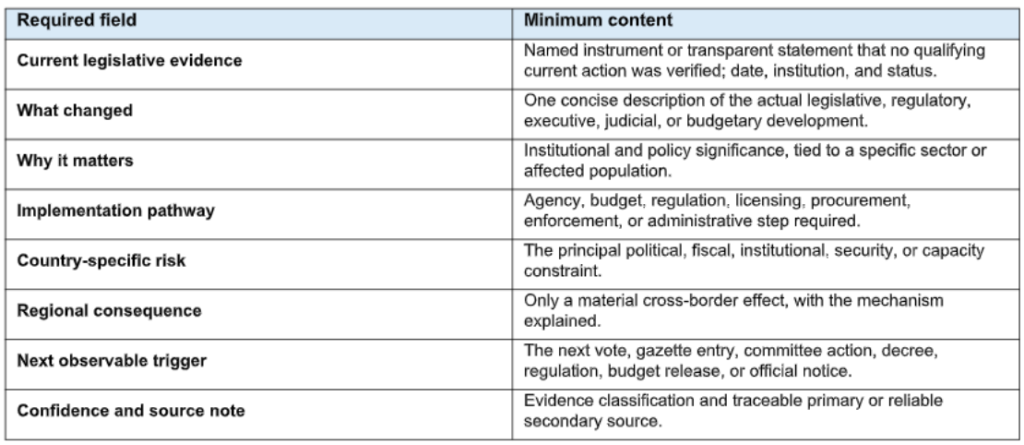
4. Required Country Entry Template — Master 9.25
5. Expanded Analytical Questions for Each Country
- Is the most important legal development parliamentary, executive, regulatory, judicial, budgetary, or externally imposed
- Does the measure change legal authority, administrative discretion, funding, enforcement, market access, or institutional accountability?
- Is the measure new, an amendment to an existing framework, an implementation step, or a restatement of policy?
- What evidence demonstrates that the measure is operational rather than merely announced?
- Which domestic actors are positioned to implement, resist, benefit from, or be constrained by the measure?
- What would count as confirmation, escalation, delay, reversal, or implementation failure?
6. Quality-Control Additions
- No country entry may rely solely on generic sector language when a current legal instrument is available.
- No current legislative claim may appear without a status label and date.
- No executive action may be described as parliamentary legislation.
- No regional implication may be asserted without identifying the cross-border mechanism.
- No 'no development' entry may be treated as proof of inactivity; it must be framed as a verification limitation.
- Country entries should normally contain one evidence paragraph, one analytical paragraph, and one watch/trigger paragraph.
- The section should preserve MENA coverage as the center of gravity while using external legal developments only as clearly labeled supporting context.
7. Editorial Outcome Expected at Master 9.25
The upgraded section should be more useful to an intelligence reader because it does not merely catalogue legal
activity. It identifies the current evidence, explains the country-specific institutional pathway, distinguishes law from
announcement, and converts uncertainty into a defined collection requirement. The objective is greater precision, not
simply greater length.
JaFaJ | MENA LEGISLATIVE INTELLIGENCE | MASTER 9.75
JaFaJ — Country-by-Country Legislative Intelligence | 6–12 September 2026
MASTER 9.25 COUNTRY-ENTRY EXPANSION
Evidence-rich country assessments, jurisdiction-specific analysis, and
operational collection guidance
This expansion converts the country section from a descriptive monitoring list into a repeatable legislative-intelligence
instrument. Each jurisdiction is assessed through three connected layers: current legislative evidence, country-specific
institutional and policy context, and analytical consequences. The framework is designed to ensure that every country
entry contains usable intelligence even when the available record is incomplete.
A. Current Legislative Evidence — 9.25 Standard
Current legislative evidence must be the center of every country entry. A country should not receive a detailed
legislative assessment solely because a sector is important. The entry must identify a current legal signal or explicitly
document the evidence limitation.
- Identify the instrument: bill, draft law, amendment, decree, regulation, budget measure, parliamentary agenda item, committee report, judicial decision, official resolution, or implementing notice.
- Identify the legal status: announced, introduced, referred, under committee review, debated, passed, promulgated, published, effective, under implementation, suspended, challenged, or repealed.
- Identify the responsible institution: parliament, named committee, cabinet, presidency, ministry, regulator, court, central bank, local authority, or recognized/de facto governing body.
- Identify the date: introduction, referral, vote, issuance, publication, effective date, or latest verified action.
- Explain the operative provision: what authority, obligation, prohibition, funding stream, licensing rule, enforcement power, institutional arrangement, or market condition changes.
- Identify the evidence level: high confidence, medium confidence, reported, incomplete, or unresolved.
- Provide a source trail: official legal database, gazette, parliamentary record, ministry publication, cabinet statement, court record, or reliable reporting used to locate the primary record.
- State the evidence gap: specify exactly what remains unverified and which official document or event would resolve it.
B. Country Specificity — 9.25 Standard
Each country entry must be unmistakably jurisdiction-specific. The analysis should explain how law is produced, who
controls implementation, and which sectors are most exposed. Generic phrases such as 'monitor economic reform'
are insufficient without a country-specific mechanism.
- Legislative operating model: parliament-centered, executive-centered, regulator-led, judicially shaped, federal/emirate-based, transitional, fragmented, or conflict-affected.
- Institutional map: identify the two to five institutions most likely to produce, interpret, fund, enforce, or obstruct the relevant measure.
- Priority sectors: select the sectors that matter most to the country’s current legal environment rather than repeating the same list for every jurisdiction.
- Affected actors: identify businesses, workers, ministries, municipalities, investors, security institutions, civil-society organizations, or vulnerable populations likely to experience the measure.
- Implementation pathway: explain the steps between legal adoption and practical effect, including regulations, budgets, licenses, procurement, appointments, enforcement, or judicial review.
- Country-specific constraint: identify the actual obstacle—political deadlock, fiscal weakness, institutional rivalry, sanctions, conflict, administrative capacity, legal ambiguity, or lack of publication.
- Country-specific trigger: name the next event that would materially update the assessment.
C. Analytical Framing — 9.25 Standard
The analytical section must move beyond description. It should explain the mechanism and consequence of the legal
development while distinguishing confirmed effects from assessment.
- Change: What is new compared with the prior legal or institutional position?
- Purpose: What policy problem, fiscal pressure, security concern, diplomatic objective, economic strategy, or institutional dispute appears to have driven the action?
JaFaJ | MENA LEGISLATIVE INTELLIGENCE | MASTER 9.75
JaFaJ — Country-by-Country Legislative Intelligence | 6–12 September 2026
- Mechanism: How does the instrument produce change—through authority, funding, licensing, enforcementmarket access, administrative control, or institutional accountability?
- Distribution: Who benefits, who bears compliance costs, and who gains or loses discretion?
- Implementation: What must happen before the measure becomes operational, and what could prevent or delay that process?
- Consequence: What are the likely domestic economic, security, diplomatic, social, or governance effects? Regional linkage: What specific cross-border mechanism connects the measure to trade, energy, migration, sanctions, investment, maritime security, humanitarian access, or diplomacy?
- Confidence: Which parts are documented facts, which are analytical inferences, and which are forward-looking judgments?
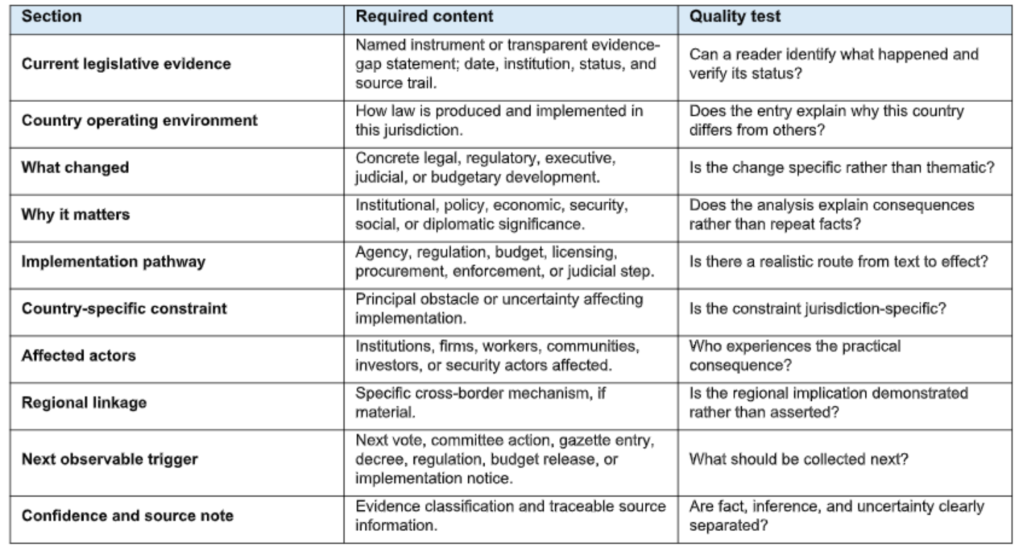
D. Mandatory Country-Entry Architecture
E. Expanded Analytical Prompts for Every Jurisdiction
- What is the strongest current legal signal available for this country during the reporting period?
- Is the signal domestic legislation, executive lawmaking, regulation, judicial action, budgetary action, or external legal pressure?
- What is the exact legal status, and what status has not yet been reached?
- Which institution has the authority to move the measure forward or prevent implementation?
- What specific policy sector or public function is affected?
- What practical obligation, power, restriction, funding stream, or market condition changes?
- What evidence indicates that the measure is operational rather than merely announced?
- What domestic actor is most likely to support, resist, benefit from, or be constrained by the measure?
- What is the principal implementation risk?
- What would confirm escalation, delay, reversal, or implementation failure?
F. Country-Specific Enhancement Directives
North Africa: Do not treat Maghreb countries as interchangeable. Separate parliamentary activity from executive
modernization, investment law, energy governance, water policy, migration rules, and territorial or nationality
questions.
Egypt: Prioritize the relationship between executive regulation, public finance, state assets, investment rules, energy
pricing, and the Suez Canal’s commercial environment.
JaFaJ | MENA LEGISLATIVE INTELLIGENCE | MASTER 9.75
JaFaJ — Country-by-Country Legislative Intelligence | 6–12 September 2026
Iraq: Track the legislative pipeline by committee, legal status, sector, and implementation authority. Distinguish
economic modernization measures from security, digital-crime, and professional-law measures.
Levant: Give greater weight to sovereignty, institutional legitimacy, security authority, public finance, reconstruction,
and the practical reach of state institutions.
Gulf: Track cabinet, royal/emirate decrees, regulators, official gazettes, and implementing decisions alongside formal
legislative bodies. Identify whether obligations apply federally, nationally, or in a special economic zone.
Conflict-affected jurisdictions: Analyze authority, recognition, territorial reach, competing instruments, humanitarian
access, fiscal control, and implementation capacity before assessing formal legislative volume.
Türkiye: Separate parliamentary legislation, presidential or administrative action, regulatory measures, and judicial
developments; identify the relevant institutional channel and economic or security consequence.
G. Final 9.25 Quality Gate
- Every country has a verification status that reflects the actual evidence reviewed.
- Every specific current claim includes an instrument, institution, date, status, or explicit source limitation.
- Every entry contains at least one country-specific institutional insight and one country-specific implementation constraint.
- Every entry distinguishes law, regulation, executive decision, judicial action, policy statement, and external legal measure.
- Every analytical paragraph explains mechanism, consequence, and uncertainty.
- Every country identifies a concrete next observable trigger.
- No generic watch area substitutes for current evidence when a qualifying instrument is available.
- No absence of evidence is described as proof of legislative inactivity.
- Cross-country conclusions are derived from identifiable country-level evidence.
- The report remains concise enough for weekly use while providing sufficient depth for professional intelligence distribution.
EXECUTIVE INTELLIGENCE SUMMARY
This edition is designed as a practical weekly monitoring instrument—not a catalogue of bills. Its purpose is to identify
verified legal and legislative developments, explain their institutional and operational significance, distinguish
confirmed activity from collection gaps, and specify the next trigger that should be monitored.
BLUF: Legislative visibility is uneven across MENA. Iraq is the principal high-confidence legislative center of gravity in
this reporting period. Tunisia and Jordan show identifiable parliamentary-process signals; Qatar shows enacted
technical-law activity; and the UAE demonstrates the continuing importance of executive and cabinet-centered legal
production.
WHAT THE READER SHOULD GET FROM EACH ENTRY
- What changed—or what could not yet be verified.
- Why the development matters to institutions, markets, citizens, or foreign actors.
- Who may be affected.
- How implementation is likely to occur.
- What specific trigger should be monitored next.
ENHANCED OPERATIONAL INTELLIGENCE STANDARD
A legislative-intelligence report becomes operational when it moves beyond the existence of a bill or legal instrument
and explains the pathway from formal action to practical consequence. Each verified development should therefore be
assessed through the following compact sequence:
- Instrument and status: identify the bill, law, decree, regulation, cabinet decision, judicial measure, or policy instrument and state its exact procedural position.
- Institutional channel: identify the authority responsible for advancing, approving, issuing, interpreting, or implementing the measure.
- Affected actors: identify the sectors, companies, ministries, workers, investors, municipalities, foreign nationals, or civil-society groups most likely to experience an effect.
JaFaJ | MENA LEGISLATIVE INTELLIGENCE | MASTER 9.75
JaFaJ — Country-by-Country Legislative Intelligence | 6–12 September 2026
- Implementation pathway: identify the regulations, licensing rules, budget allocations, administrative instructions, enforcement actions, or institutional delegations that will determine practical impact.
- Operational meaning: explain the likely change in obligations, permissions, costs, access, risk, authority, or compliance requirements.
- Next trigger: identify the next event that would confirm movement, delay, modification, or failure to implement.
- Collection priority: specify the official source or institutional channel that should be checked first in the next reporting cycle.
EDITORIAL CONSISTENCY STANDARD
All country entries should follow one architecture and one vocabulary. The report must distinguish proposed
legislation, committee action, parliamentary debate, passage, promulgation, effective law, executive regulation,
cabinet decision, judicial measure, administrative action, policy statement, and external legal development. The
phrase “no qualifying current legislative action was verified” is a source-status finding; it must never be presented as
proof of inactivity.
Each entry should use the same order: Verification Status; Current Evidence; What Changed; Why It Matters;
Implementation Pathway; Affected Actors; Country-Specific Constraint; Regional Relevance; Next Trigger; Confidence
and Source Note.
PUBLICATION-READINESS STANDARD
The report is intended to function as a standalone JaFaJ weekly intelligence publication. It should be concise enough
for recurring use, sufficiently documented for research, and operationally useful to policymakers, businesses,
investors, diplomats, journalists, researchers, and institutional monitors.
- One authoritative edition label throughout the document.
- Uniform reporting-period and publication-date treatment.
- Consistent country-entry headings and terminology.
- Visible source trails for every current substantive claim.
- Clear separation of verified evidence, inference, and collection gaps.
- No duplicated production-prompt language in the reader-facing report.
- Consistent headers, footers, page breaks, capitalization, punctuation, and confidence language.
- Final verification that every stated next trigger is specific enough to guide the next collection cycle.
MASTER 9.75 FINAL QUALITY GATE
- Every current claim identifies an instrument, institution, date, status, and source trail—or clearly states that no qualifying instrument was verified.
- Every entry distinguishes legislative, executive, regulatory, judicial, policy, and external legal activity.
- Every substantive development includes affected actors, implementation pathway, operational meaning, and next trigger.
- Country entries remain country-specific and do not substitute generic regional commentary for evidence.
- The report does not equate absence of verified evidence with inactivity.
- The document is tight, readable, professionally controlled, and useful without requiring the reader to know the underlying production prompt.